Is capital gains tax on NEPSE trading considered a final tax under Inland Revenue Department rules?
For ordinary individual retail investors, the CGT deducted at source by clearing brokers is treated as a final withholding tax under current Inland Revenue Department guidelines. However, institutional investors and commercial trading entities must treat this deduction as advance tax and file comprehensive annual returns.
When you sell shares on the Nepal Stock Exchange (NEPSE) through your broker’s Trade Management System (TMS), the payout hitting your bank account is always lower than your gross turnover. Beyond broker commissions, SEBON regulatory fees, and depository participant charges, the most substantial deduction on profitable trades is Capital Gains Tax (CGT).
For both beginners taking profits on their first IPO and active swing traders rebalancing their secondary market portfolio, understanding how CGT works in Nepal is essential. Mistakes in calculating your cost price or misjudging your holding period can lead to surprise tax deductions or unnecessary delays during MeroShare electronic settlement.
This comprehensive guide explains the current capital gains tax rates in Nepal, the difference between short-term and long-term holdings, how bonus and right shares are taxed, and how to verify your exact tax liability step-by-step.
What is Capital Gains Tax (CGT) in Nepal’s Stock Market?
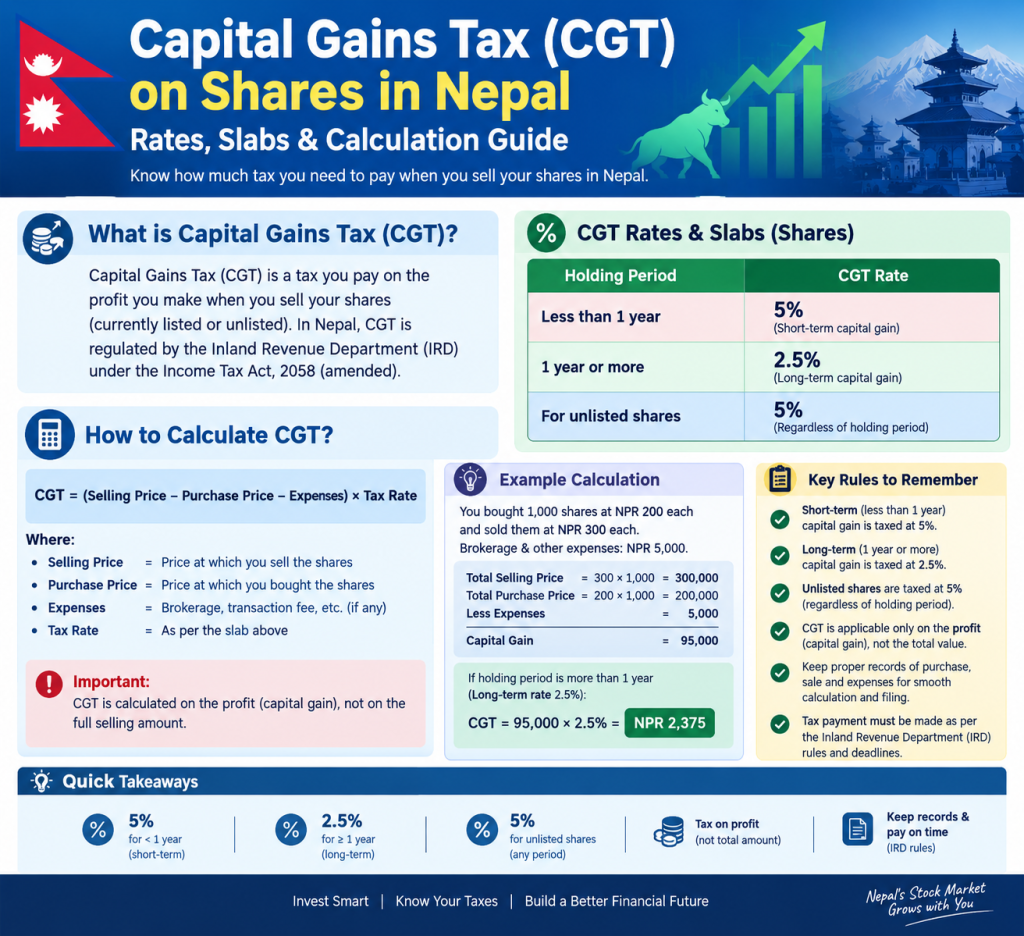
Capital Gains Tax (CGT) is a direct tax levied on the profit realized from the sale of non-business assets or capital assets, such as shares of listed companies, mutual funds, debentures, and real estate. Under the directives of the Inland Revenue Department (IRD) and the Securities Board of Nepal (SEBON), CGT is applicable only when you make a net profit from selling your securities.
If you sell shares at a price lower than your actual purchase cost (a net capital loss), you do not owe any capital gains tax on that transaction. Furthermore, CGT is not calculated on your total gross sales value; it is strictly applied to your net gain after deducting allowable statutory trading costs.
Current CGT Slabs for Individual and Institutional Investors
The Government of Nepal classifies stock investors into distinct categories based on residency and legal status. For individual retail investors, the tax structure rewards patient investors by setting lower rates for extended holding periods.
| Investor Category | Holding Period | CGT Rate |
|---|---|---|
| Resident Individual | Short-Term (≤ 365 Days) | 7.5% |
| Resident Individual | Long-Term (> 365 Days) | 5.0% |
| Resident Institutional / Corporate Entity | Any Duration | 10.0% |
| Non-Resident Individual / Foreign Entity | Any Duration | 25.0% |
Note: Tax rates and thresholds are set by the annual Finance Act passed by the Parliament of Nepal. Investors should verify active provisions with the Inland Revenue Department (IRD) or their licensed stockbroker for any mid-year fiscal circular amendments.
Short-Term vs. Long-Term Holding Periods: How the 365-Day Rule Works
The division between a short-term investor and a long-term investor in Nepal hinges on the 365-day holding threshold:
- Short-Term Holding (≤ 365 days): If you sell your shares within 365 days of acquiring them, your net profit is taxed at 7.5%.
- Long-Term Holding (> 365 days): If you hold your shares for 366 days or more before executing a sell order, your net profit is taxed at the discounted rate of 5.0%.
How Does CDSC Calculate the Holding Period?
CDS and Clearing Limited (CDSC) tracks your purchase date based on when the securities were credited to your Demat account. In the MeroShare system, whenever you prepare to transfer shares following a sell order, you are required to access the “My Holdings” module. There, the system automatically checks your acquisition date against the trade execution date.
If you hold multiple purchase lots of the same stock acquired at different dates, CDSC applies the FIFO (First In, First Out) principle. Under FIFO, the shares you bought earliest are assumed to be sold first, which often allows seasoned holdings to qualify for the favorable 5% long-term rate.
Step-by-Step Capital Gains Tax Calculation Formula
To determine your exact CGT liability, you must calculate your net selling price, subtract your total acquisition cost, and apply the relevant tax rate.
1. The Core Formulas
- Gross Sale Amount = Sold Quantity × Selling Price per Share
- Net Sale Amount = Gross Sale Amount − (Broker Commission + SEBON Fee + DP Transaction Charge)
- Total Purchase Cost = Sold Quantity × Weighted Average Cost of Capital (WACC)
- Net Capital Gain = Net Sale Amount − Total Purchase Cost
- Capital Gains Tax (CGT) = Net Capital Gain × Applicable Rate (5% or 7.5%)
2. Realistic NEPSE Calculation Example
Suppose you purchased 100 shares of a commercial bank at an all-in cost (WACC) of NPR 300 per share. Your total acquisition cost is NPR 30,000. After holding the stock for 400 days (making you a long-term investor subject to 5% CGT), you sell all 100 shares at NPR 450 per share through your NEPSE broker TMS account.
- Gross Selling Amount: 100 × NPR 450 = NPR 45,000
- SEBON Regulatory Fee (0.015%): NPR 6.75
- Broker Commission (approx. 0.37% for this slab): NPR 166.50
- Depository Participant (DP) Fee: NPR 25.00
- Total Selling Expenses: NPR 6.75 + NPR 166.50 + NPR 25.00 = NPR 198.25
- Net Sale Amount: NPR 45,000 − NPR 198.25 = NPR 44,801.75
- Total Purchase Cost: 100 × NPR 300 = NPR 30,000.00
- Net Capital Gain: NPR 44,801.75 − NPR 30,000.00 = NPR 14,801.75
- Capital Gains Tax (5% Long-Term): NPR 14,801.75 × 0.05 = NPR 740.09
Had you sold these shares within 365 days, your CGT rate would have been 7.5%, resulting in a tax deduction of NPR 1,110.13 (NPR 14,801.75 × 0.075).
Tax Treatment of IPOs, Bonus Shares, and Right Shares
Different corporate actions impact your cost base and your CGT computation differently. Understanding how each is treated prevents calculation errors in MeroShare.
1. Initial Public Offerings (IPOs)
For ordinary primary shares allotted at par value, your base cost per share is almost always NPR 100 (or the specific allotment price if issued at a premium). When selling, you only pay CGT on the profit made above this NPR 100 benchmark. If you were allotted shares over a year ago, you will be charged the 5% long-term rate upon selling.
2. Bonus Shares (Stock Dividends)
When listed companies distribute bonus shares, the tax implications can be two-fold:
- Dividend Tax at Source: The company or the shareholder must settle the mandatory 5% cash dividend tax on the face value of the bonus distribution before the shares are credited to the investor’s Demat account.
- Base Cost for CGT: Under standard CDSC WACC guidelines, bonus shares carry a default base purchase price of NPR 100 (the par value). When you sell these bonus shares on NEPSE, your profit is calculated as the difference between your net selling rate and the NPR 100 par value.
3. Right Shares
When you subscribe to right shares via MeroShare, you pay the face value of NPR 100 per unit. Therefore, the acquisition cost for right shares is established at NPR 100 per share plus any nominal C-ASBA charges paid during subscription. When pooled with your secondary market purchases, these shares dilute and adjust your aggregate WACC downward.
How MeroShare WACC Feeds Directly into Your CGT Liability
Your Weighted Average Cost of Capital (WACC) is the single most important number determining your tax bill. If your WACC is calculated higher than it should be, your taxable profit shrinks; if it is calculated lower, you pay more tax than required by law.
Before transferring any sold shares, you must compute your acquisition cost using the “My Purchase Source” tab on CDSC’s portal. If you need step-by-step guidance, follow our walkthrough on how to calculate WACC in MeroShare. Once you calculate and confirm the WACC, you must go to “My Holdings” to declare your holding duration (short-term vs. long-term). The system locks these figures and forwards them automatically to your clearing broker.
Settlement Process: How Brokers Collect and Remit CGT via EDIS
Nepal operates under a Source Deducted Tax model for secondary equity transactions. You do not need to visit a tax office in person to pay CGT on normal stock trades; the entire mechanism is automated:
- Execute Sell Order: You place and execute your sell order on the NEPSE TMS portal.
- Declare WACC and Holdings: On the same evening or the following morning (T+1), you log into MeroShare, compute your purchase source, and declare whether each sold batch is short-term or long-term.
- Transfer via EDIS: You submit the shares to the clearing pool by completing the MeroShare EDIS share transfer process.
- Broker Clearing & Tax Deduction: The clearing house calculates the final net payable amount. Your broker deducts the applicable 5% or 7.5% CGT along with commissions and fees directly from your gross proceeds.
- Net Settlement: The broker deposits the remaining net balance into your linked bank account via ConnectIPS or NCHL-IPS and remits the withheld CGT directly to the Inland Revenue Department under their registered PAN.
Is CGT a Final Withholding Tax for Retail Investors in Nepal?
One of the most frequently debated topics in the Nepali capital market has been whether the capital gains tax deducted by brokers represents a Final Withholding Tax or an advance tax requiring year-end tax returns.
According to clarifications from the Ministry of Finance and the Inland Revenue Department following amendments to the Income Tax Act:
- Natural Persons (General Retail Investors): For individual, non-business investors who trade shares in their personal capacity, the 5% (long-term) or 7.5% (short-term) CGT deducted at source by stockbrokers is treated as a final tax. Individual investors are generally not required to bundle these capital gains into their regular employment or business income slabs for progressive taxation.
- Institutional and Business Entities: For registered private firms, public companies, and proprietary trading desks whose core registered business includes securities trading, the CGT deducted at source acts as an advance tax. These entities must audit their annual accounts and reconcile their capital gains with overall corporate income tax brackets (typically 25% or 30%).
Final Thoughts for NEPSE Investors
Capital Gains Tax is a natural part of profitable stock trading. By understanding the 365-day threshold, keeping an accurate record of your purchase sources, and properly maintaining your WACC on MeroShare, you can ensure that you pay only what you legally owe while avoiding settlement penalties on NEPSE.
Frequently Asked Questions (FAQs)
What is the current capital gains tax rate for individual share investors in Nepal?
Resident individual investors pay 7.5% CGT on profits from shares held for 365 days or fewer (short-term). For shares held longer than 365 days (long-term), the tax rate drops to 5.0%.
How does CDSC calculate whether a share holding is short-term or long-term?
CDSC compares the date the shares were originally credited to your Demat account with the date the sell order was executed on NEPSE. If the difference is 365 days or less, it is classified as short-term. If it exceeds 365 days, it is classified as long-term under the First In, First Out (FIFO) rule.
Do you pay capital gains tax if you sell shares at a net loss?
No. Capital Gains Tax is only charged on positive net profits. If your net sale proceeds (after deducting brokerage and SEBON fees) are less than your purchase cost (WACC), your tax liability is NPR 0.
How is capital gains tax determined for bonus shares received from listed companies?
Bonus shares carry a standardized base purchase cost of NPR 100 per share in MeroShare WACC. When you sell them, any amount received above the NPR 100 benchmark (minus selling charges) is considered capital gain and taxed at either 5% or 7.5%, depending on how long you held them after allotment.
Is capital gains tax on NEPSE trading considered a final tax under Inland Revenue Department rules?
For ordinary individual retail investors, the CGT deducted at source by clearing brokers is treated as a final withholding tax under current Inland Revenue Department guidelines. However, institutional investors and commercial trading entities must treat this deduction as advance tax and file comprehensive annual returns.