Initial Public Offerings (IPOs) have revolutionized how ordinary citizens in Nepal build personal wealth. Over the last few years, millions of investors have turned to the primary market, drawn by the par issue price of Rs. 100 per share and the relative safety compared to secondary market volatility. However, many retail investors only find out about an IPO a day before it opens—or worse, after the subscription window has closed.
By learning how to monitor an upcoming IPO in Nepal directly from regulatory sources, you can prepare your capital, analyze the issuer’s fundamentals, verify your accounts, and avoid the last-minute rush. This practical guide walks you through reading the official regulatory pipeline, understanding quota allocations, and preparing your accounts well ahead of time.
What Is an Upcoming IPO and How Does the Public Offering Process Work in Nepal?
An Initial Public Offering (IPO) is the process through which a private company or an unlisted public company issues fresh shares to the general public for the first time, subsequently listing those securities on the Nepal Stock Exchange (NEPSE). In Nepal, this entire process is strictly supervised by the Securities Board of Nepal (SEBON) under the Securities Act and prevailing Public Issue Regulations.
A company does not simply announce an IPO overnight. Before shares reach your MeroShare dashboard, the issuer must complete several regulatory and operational phases:
- Appointment of Issue Manager: The issuing company appoints a licensed Merchant Banker (Capital) to structure, manage, and underwrite the public offering.
- Audited Financials and Due Diligence: The issuer prepares comprehensive financial reports, gets its net worth certified, and drafts an initial prospectus.
- Credit Rating Assessment: Eligible issues undergo risk rating from domestic rating agencies (such as ICRA Nepal, CARE Ratings Nepal, or Infomerics Nepal).
- Formal Application to SEBON: The Issue Manager submits a formal application requesting regulatory permission to float shares to the public.
- Regulatory Review and Revisions: SEBON assesses compliance, issues queries or requests corrections, and the merchant banker submits revised documentation.
- Official Approval: Once satisfied, the SEBON board grants approval.
- Notice Publication: The company publishes its formal offer document (Awhan Patra) in national daily newspapers and digital channels, setting the exact subscription dates.
How to Check the Official SEBON IPO Pipeline (Preliminary Review vs. Approved List)
Instead of relying on unverified social media claims, smart investors monitor the primary source: the Securities Board of Nepal (SEBON) website. SEBON maintains a public register detailing every company waiting to issue shares.
Step-by-Step: Finding the Pipeline on SEBON’s Portal
- Visit the official SEBON website at
sebon.gov.np. - Navigate to the Public Issue or Pipeline section from the main menu.
- Locate the IPO Pipeline table (SEBON periodically updates these tables under both English and Nepali sections).
Understanding Pipeline Categories
When you open the pipeline document or webpage, you will encounter companies classified under distinct operational statuses:
- Under Preliminary Review: The company has submitted its application, but SEBON officials are still conducting initial checks regarding documentation, capital structure, and regulatory eligibility.
- Reviewed and Comment Sent: SEBON has completed its initial review and sent formal queries or requests for amendments back to the Issue Manager.
- Replied and Under Review: The merchant banker has answered SEBON’s queries and submitted amended documents. The board is verifying whether the changes satisfy all legal guidelines.
- Approved: SEBON has formally sanctioned the issue. Once a company moves to the approved list, the public issue typically opens within 15 to 45 days.
Monitoring these stages gives you several months of advance visibility into which hydropower projects, manufacturing companies, microfinances, or hotels are about to raise capital.
Understanding IPO Quotas in Nepal: Project-Affected, Remittance, Mutual Funds, and General Public
An upcoming IPO in Nepal rarely opens to everyone simultaneously. SEBON regulations mandate phased offerings with specific reservations to ensure equitable access and support specific demographics.
1. Project-Affected Local Residents
Primarily common in hydropower and manufacturing projects, a mandatory quota (typically 10% of the total issued capital for hydropower) is reserved for local residents of the district or rural municipality where the project is constructed. This phase opens first. Locals often have a lock-in period on their shares (typically three years from allotment) to prevent immediate market dumping.
2. Nepalese Employed Abroad (Remittance Quota)
To incentivize remittances through formal banking channels, SEBON mandates a 10% reserved quota of the general public issue for Nepali citizens working abroad with valid government labor permits. If you work overseas, opening a specialized Remittance MeroShare account allows you to subscribe to this exclusive allocation before the general issue opens.
3. Institutional Quotas: Mutual Funds and Employees
Before shares reach retail desks, small percentages are carved out:
- Collective Investment Schemes (Mutual Funds): Usually allocated 5% of the general public quota.
- Company Employees: Up to 2% to 5% may be reserved for full-time staff, depending on sector bylaws and company charters.
4. The General Public Phase
After local and foreign employment allocations are processed, the remaining unallocated shares open for the wider public residing in Nepal. This is the stage where anyone with a basic Demat account and valid CRN can apply, generally at 10 units minimum.
How to Evaluate an Upcoming IPO: Credit Ratings, Net Worth, and the Prospectus (Awhan Patra)
Not all public issues guarantee instant listing gains. Analyzing the offer document before applying helps prevent tying up your capital in fundamentally weak enterprises.
1. Scrutinize the Credit Rating
Credit rating agencies assign alphanumeric grades reflecting default risk and financial stability. For example:
- Care-NP AAA / [ICRANP-IR] AAA: Highest safety and lowest credit risk.
- Care-NP BBB / [ICRANP-IR] BBB: Moderate safety and moderate credit risk.
- Care-NP BB / [ICRANP-IR] BB or Below: Moderate to high credit risk, indicating weaker debt-servicing ability.
Pay close attention to issuer ratings, especially for debt-heavy hydropower projects with long gestation periods.
2. Examine the Net Worth Per Share and Accumulated Reserves
Look at the company’s audited Net Worth Per Share (Book Value). If a company is issuing shares at Rs. 100 per share, its net worth per share should ideally exceed Rs. 100. If an entity carries heavy accumulated losses and a book value well below par, secondary market opening prices may disappoint.
3. Check Project Status and Simple Payback Period
For infrastructure ventures, check the commercial operation date (COD), per-megawatt construction cost, and the simple payback period stated in the prospectus. A cost significantly exceeding Rs. 20–22 Crore per MW for run-of-the-river hydropower requires deeper financial scrutiny.
Where to Find Verified IPO Opening and Closing Dates in Nepal
Once SEBON grants approval, the issue manager publishes an official notice called the Awhan Patra (Offering Notice). You can find verified subscription windows through these primary channels:
- MeroShare Portal: Log in and check the “My ASBA > Applicable Issue” section. Only live, verified offerings appear here.
- Issue Manager Websites: Merchant bankers (such as Global IME Capital, Nabil Investment, NIBL Ace Capital, Sanima Capital, etc.) publish comprehensive prospectuses and date notices on their official websites.
- National Daily Newspapers: Companies are legally bound to publish full notices in recognized national print dailies (like Gorkhapatra, Kantipur, or The Himalayan Times).
- Trusted Market Data Portals: Financial analytics portals accurately list opening, earliest closing, and extended closing dates based on official notices.
Note on Closing Dates: Most public offerings specify an “Earliest Closing Date” (usually 4 banking days after opening) and an “Extended Closing Date” (up to 14 to 15 days). If an issue receives full subscription by day 4—which is typical for general public IPOs in Nepal—it closes immediately without extension.
Essential Checklist to Prepare Your Demat and MeroShare Before an IPO Opens
High demand often leads to heavy server loads during the final hours of subscription. Completing this checklist ahead of time prevents failed applications and missed opportunities.
1. Confirm an Active Demat Account
If you have not yet entered the primary market, your first priority is to open a Demat account online through a registered Depository Participant (bank or broker). Ensure your 16-digit Beneficiary Owner Identification Number (BOID) is active.
2. Renew Expired Accounts
Demat and MeroShare accounts require annual renewal. If your portal access is suspended due to an expired subscription, take a moment to renew your MeroShare account online using digital wallets like eSewa, Khalti, or ConnectIPS.
3. Verify Your C-ASBA and CRN Details
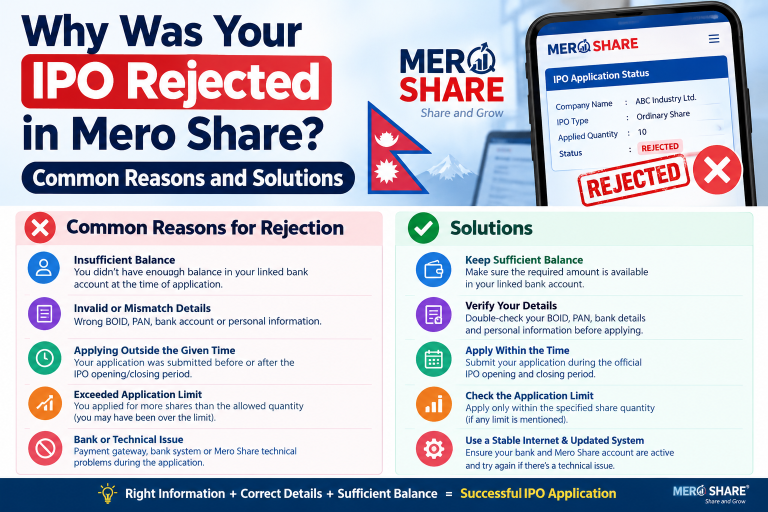
To block funds during an application, your bank account must be linked to Centralized Applications Supported by Blocked Amount (C-ASBA). Make sure you verify your CRN number with your branch before the issue goes live. Without an authenticated CRN, MeroShare will reject your request.
4. Maintain Adequate Unencumbered Balance
When applying for 10 units at Rs. 100 per share, you need at least Rs. 1,000 available in your bank account, plus any small C-ASBA processing fee your bank charges (typically Rs. 0 to Rs. 5 per application). Ensure these funds are unblocked and readily available for lien placement.
Once everything is verified, you can smoothly apply for an IPO via MeroShare on opening day and subsequently check your IPO allotment result when CDS and Clearing Limited finalizes the lottery.
Conclusion
Navigating upcoming IPOs in Nepal no longer requires guesswork. By tracking the official SEBON pipeline, understanding how quotas flow from project-affected locals to the general public, and reviewing financial indicators in the prospectus, you can position yourself as an informed investor. Keep your MeroShare, Demat, and bank C-ASBA linkages active so you are ready whenever a quality company enters the market.
Frequently Asked Questions (FAQs)
How can I check the status of pending IPOs awaiting SEBON approval?
You can monitor pending public issues by visiting the official SEBON website (sebon.gov.np) under the Public Issue / Pipeline section. The table displays applications categorized under Preliminary Review, Reviewed & Comments Sent, and Replied & Under Review.
How long does SEBON usually take to approve a company’s IPO application?
There is no fixed statutory timeline. Depending on the completeness of documentation, regulatory compliance, merchant banker responsiveness, and board-level meetings, approval can take anywhere from two months to well over a year.
Why do foreign employment quota IPOs open before the general public issue?
SEBON regulations require the 10% remittance quota to open and close prior to the general offering. This allows issue managers to reconcile foreign employment subscriptions, adjust any unsubscribed shares back into the general public pool, and avoid quota overlaps.
Where can I read the official IPO prospectus (Awhan Patra) before applying?
The full prospectus and abbreviated offer notices are published on the website of the designated Issue Manager (Merchant Banker), the issuing company’s official website, and national print dailies prior to the opening date.
How many days does an IPO stay open for subscription in Nepal?
Under standard SEBON guidelines, public offerings remain open for a minimum of 4 banking days (earliest closing date). If the issue is undersubscribed, it can be extended up to 15 days. However, almost all general public issues in Nepal are oversubscribed rapidly and close on the 4th day.
Can I apply for an upcoming IPO if my MeroShare account is recently registered?
Yes. As long as your Demat account is activated, your MeroShare portal is operational, and your bank has linked your C-ASBA Registration Number (CRN), you can apply immediately once an issue opens.