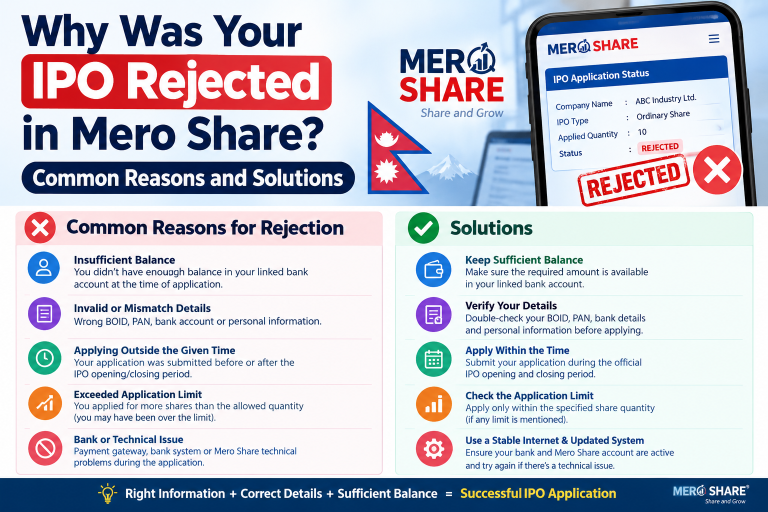
Applying for Initial Public Offerings (IPOs) through the Mero Share portal has made participating in Nepal’s primary stock market simple for retail investors. However, after the allotment process concludes, thousands of investors encounter a frustrating issue: their bank statement shows money on hold or locked under a C-ASBA lien, even though they were not allotted any shares.
If your account balance reflects a difference between your Total Balance and Available Balance days after an allotment, you are not alone. This guide explains how the C-ASBA system holds funds in Nepalese commercial and development banks, why delays occur, and the exact steps to unblock your funds fast.
Understanding C-ASBA Lien: Why IPO Funds Are Held Rather Than Debited
Before the introduction of the C-ASBA (Centralized Application Supported by Blocked Amount) system by CDS and Clearing Limited (CDSC) under SEBON regulations, applying for an IPO required drawing physical cheques or directly transferring cash. Money was deducted immediately, and non-allotted applicants had to wait weeks or months for physical refund cheques.
Under the modern C-ASBA framework, your money never leaves your bank account when you apply for an IPO. Instead, your bank places a financial lien (a temporary freeze or lock) on the exact amount required for the application.
Key aspects of the C-ASBA lien system include:
- Interest Accrual: Because the funds remain inside your savings account, you continue earning interest on the blocked amount until actual debit or lien release.
- Available vs. Total Balance: Your mobile banking app will display your full deposit under Total Balance, but the applied IPO amount is subtracted from your Available Balance to prevent double-spending.
- Debit on Allotment: The bank only debits funds from your account if you win shares during the allotment draw conducted by the issue manager.
If you suspect an issue during the application phase itself, read our detailed guide on why IPO applications get rejected in Mero Share to rule out system rejections.
How Long Does It Take to Unfreeze Non-Allotted IPO Money in Nepal?
Normally, C-ASBA lien releases occur automatically within 2 to 5 working days after the official allotment result is published by the issue manager.
The unblocking workflow involves several sequential technical handshakes across multiple institutions:
- Allotment Finalization: The merchant banker (issue manager) completes the allotment logic and generates two electronic files: an Allotment File (investors who won shares) and an Unblock/Lien Release File (investors who were not allotted shares).
- CDSC Data Distribution: The issue manager submits the unblock instruction file to CDSC, which processes the records and routes the clearing instructions to respective member banks via the C-ASBA network.
- Bank Clearing Script Execution: Each commercial or development bank receives the automated list and runs end-of-day (EOD) or batch scripts inside their Core Banking Software (CBS) to lift the lien from individual accounts.
While this process is largely automated, delays happen if any node in the data transmission pipeline encounters technical backlogs or file verification errors.
Top Reasons Your IPO Amount Remains Blocked After Allotment
If several working days have passed since you checked your Mero Share IPO allotment result and confirmed zero allotment, your funds may remain stuck due to one of the following root causes:
1. Core Banking Software (CBS) Batch Processing Delays
When millions of retail investors apply for a popular IPO, banks receive massive electronic instruction files simultaneously. Some bank IT systems process lien releases in micro-batches over multiple nights rather than all at once, leading to release delays for certain account ranges.
2. Data Discrepancies and Mismatched CRN Details
If there is a slight discrepancy between your Demat name, bank account name, or citizenship number, automated script matching can fail. When an automated unblock script encounters a record mismatch, it skips that specific line item to prevent clearing errors, leaving your lien active until manual intervention.
3. Bank Mergers and Branch Code Changes
In Nepal’s banking sector, frequent bank mergers lead to updated account numbering structures, revised branch routing codes, and changed SWIFT/CBS codes. If your CRN number was registered under an old bank branch format prior to a merger, the unblock signal sent by CDSC may fail to locate your updated account balance automatically.
4. Pending Interbank Settlement Between Issue Manager and Clearing Banks
Occasionally, the issue manager encounters reconciliation issues with the central clearing bank before releasing final authorization keys to CDSC. Until the issue manager signs off on the master clearing file, banks cannot release applicant holds.
Step-by-Step Process to Unblock Stuck IPO Money in Your Bank
If your IPO funds remain frozen beyond 4–5 working days post-allotment, follow this step-by-step troubleshooting path to resolve the issue:
Step 1: Confirm Allotment Status on Official Portals
First, verify your allotment status across official channels such as CDSC’s official IPO result site (iporesult.cdsc.com.np) or the issue manager’s portal. Ensure your status is marked as Not Allotted or Rejected, and record your 16-digit Beneficiary Owner ID (BOID) and Application Reference Number.
Step 2: Check Bank Account Statement and Lien Log
Log in to your mobile banking application or internet banking portal. Check your account summary or statement details for specific status terms:
- Available Balance: The money you can freely withdraw or transfer.
- Total/Actual Balance: Includes your available funds plus frozen lien amounts.
- Lien/Hold Details: Some apps (e.g., Global Smart, Nabil SmartBank, eBanking) explicitly list active holds under a C-ASBA Lien tab with an application ID.
Step 3: Contact Your Bank’s C-ASBA or Clearing Desk
Contact your bank branch’s C-ASBA department or customer support. Avoid general customer service lines when possible; request to speak directly with the C-ASBA Operations / Clearing Unit.
Provide them with the following details:
- Full Name & Bank Account Number
- 16-digit Demat BOID Number
- Name of the IPO / Company Applied For
- Application ID / CRN Number
- Blocked Amount (e.g., NPR 1,000 for 10 units)
The clearing officer will cross-reference your application ID against the bank’s exception list and execute a manual CBS lien removal command.
Step 4: Send an Official Unblock Request Email
If telephone support does not resolve the hold within 24 hours, draft an official email to your bank’s central customer support and C-ASBA desk. Copy the issue manager’s official email address in the same thread.
Subject: Request to Release C-ASBA Lien Hold - [Company Name IPO] - Account [Your Account No] Dear C-ASBA Department, I applied for the IPO of [Company Name] using my Mero Share account. As per official allotment records, I was not allotted any shares. However, the application amount of NPR [Amount] remains blocked under lien in my bank account. Account Details: - Account Name: [Your Full Name] - Bank Account Number: [Your Account Number] - 16-Digit BOID: [Your BOID] - CRN Number: [Your CRN] - IPO Applied: [Company Name] - Application Reference ID: [Application ID] Kindly request you to manually verify and release the C-ASBA hold on my available balance at the earliest. Sincerely, [Your Full Name] [Contact Number] How to Identify and Contact the Issue Manager for Lien Clearance
If your bank reports that they have not received an unblock clearance instruction file for your BOID, the issue lies with the Issue Manager (Merchant Banker) managing the public offer.
To identify the issue manager for any public issue:
- Open your Mero Share account, navigate to My ASBA, and check the Application Report tab for the relevant company.
- Look for the designated merchant capital name listed on the offer prospectus (e.g., Global IME Capital, Nabil Investment Banking, NIMB Ace Capital, Prabhu Capital, Sanima Capital, etc.).
- Visit the merchant banker’s official website and navigate to their C-ASBA Support / Helpline Desk.
When contacting the issue manager, ask their settlement team to verify whether your BOID was included in the primary batch instruction file sent to CDSC and your specific bank.
Partial Allotment: How Banks Handle Lien Release for Remaining Unallocated Shares
In cases involving high-value issues, corporate debentures, or right share offerings where partial allotments take place, retail investors may be allotted fewer shares than they applied for.
Here is how the lien release works for partial allotments:
- Total Hold Applied: If you applied for 100 units at NPR 100 each, the initial lien placed on your account is NPR 10,000.
- Partial Allotment: If you are allotted 40 units, the cost of the allotted shares is NPR 4,000.
- Execution by Bank: The bank debits NPR 4,000 from your account to settle the allotted shares, and simultaneously releases the remaining NPR 6,000 lien back to your available balance.
If your account shows that the full applied amount was debited despite partial allotment, immediately notify both your bank and the issue manager with your transaction statement as proof.
Best Practices to Avoid Future C-ASBA Freeze Delays
While technical glitches cannot always be controlled, following these best practices helps minimize C-ASBA hold issues in future IPO issues:
- Keep KYC Updated: Ensure your Bank KYC, Demat KYC, and Mero Share details are fully updated and synchronized across all portals. If you updated your bank details recently, follow our guide on how to change your bank account in Mero Share and Demat to avoid broken links.
- Select Banks with Reliable C-ASBA Systems: Check processing speed and review bank-wise C-ASBA fee structures and processing rules to choose financial institutions known for fast automated lien removals.
- Avoid Last-Minute Modifications: Avoid applying for an IPO multiple times or editing applications right before the deadline, as rapid status changes can lead to orphan lien entries inside CBS databases.
Frequently Asked Questions (FAQs)
1. Why is my bank balance showing money on hold even though I did not get any IPO shares?
When you apply for an IPO in Nepal via C-ASBA, your bank places a lien (temporary hold) on the applied funds. If you do not win any shares during allotment, your money is not debited, but the hold remains active until the bank processes the electronic release instructions sent by the issue manager and CDSC.
2. Does the bank deduct the money and refund it, or just release the hold?
The bank does not deduct your funds and refund them. Under C-ASBA rules, funds remain inside your savings account under a hold status. Once released, the hold is removed, restoring your Available Balance to match your Total Balance without any incoming transfer transaction entry.
3. How many days after IPO result announcement does C-ASBA lien release take?
In most cases, banks automatically lift the lien within 2 to 5 working days post-allotment. If official holidays fall immediately after the allotment, processing may take longer as batch clearing scripts run on banking working days.
4. Who should I contact first if my IPO money remains frozen for more than a week: my bank or the issue manager?
You should contact your bank’s C-ASBA/clearing desk first. Provide your BOID and application ID so they can check if an unblock signal was received. If your bank confirms that no clearance data file was received for your BOID, contact the issue manager (merchant banker) handling the IPO.
5. Can a bank charge an extra fee to release a blocked IPO amount?
No, commercial and development banks in Nepal are strictly prohibited from charging any fee to unblock or release C-ASBA holds. Banks are only permitted to charge standard C-ASBA application fees (if applicable) at the time of initial application submission as per SEBON guidelines.