Decades ago, investing in the Nepalese capital market meant receiving printed paper certificates as physical proof of stock ownership. Investors stored these paper certificates in lockers, waiting for annual general meetings (AGMs) or dividend collection notices. However, with the establishment of CDS and Clearing Limited (CDSC) and the full digitization of the Nepal Stock Exchange (NEPSE), physical share certificates are no longer usable for active market trading or streamlined dividend collection.
If you or your family members hold old paper share certificates of listed companies in Nepal, dematerialization is the mandatory process required to bring those shares into your modern electronic account. Converting paper shares into electronic form allows you to view them on your MeroShare dashboard, sell them via a broker’s Trade Management System (TMS), and automatically receive bonus shares and cash dividends directly into your bank account.
This comprehensive guide explains the complete step-by-step process of converting physical share certificates into Demat format in Nepal, including the documents required, handling common issues like name discrepancies, and tracking your submission.
What Is Dematerialization (Dematting) of Shares?
Dematerialization—commonly referred to as “dematting”—is the process of converting physical paper share certificates into an electronic format. Once dematerialized, your physical certificates are canceled by the issuing company’s Registrar to Shares (RTS), and an equivalent number of digital shares are credited directly to your 16-digit Beneficiary Owner Identification (BOID) number maintained with a Depository Participant (DP).
Before full electronic trading was implemented in Nepal, every share transaction produced paper records. Today, CDSC operates as the central depository overseeing all digital holdings in Nepal. Without converting your physical shares to Demat, your equity remains locked in paper form, preventing you from liquidating your holding or participating cleanly in modern corporate benefits.
Why Must You Convert Physical Shares to Demat in Nepal?
Holding physical share certificates in today’s electronic Nepalese stock market presents major operational challenges. Here is why converting paper shares to Demat is essential:
- Trading Requirement on NEPSE: Physical share certificates cannot be sold on NEPSE. Stockbrokers can only execute sell orders for shares held electronically inside your Demat account.
- Protection Against Loss or Damage: Physical certificates are vulnerable to theft, moisture damage, fire, or accidental loss. Dematerialized shares are stored securely in CDSC’s central electronic vault.
- Automated Corporate Actions: When listed companies declare bonus shares or rights issues, paper holders must manually visit merchant banks to collect physical updates. Electronic shares receive bonus credits directly into their Demat account without physical paperwork.
- Direct Cash Dividend Deposits: Cash dividends are remitted via national automated clearing systems directly to the bank account linked with your Demat account, eliminating physical dividend warrants. If you need to update your bank details, you can read our guide on how to change bank account in Mero Share and Demat.
- Portfolio Visibility: Converting paper certificates puts your complete financial holding onto your MeroShare portal, allowing you to calculate portfolio value, evaluate purchase history, and handle tax obligations smoothly.
Prerequisites Before Starting the Conversion Process
Before visiting your Depository Participant or Registrar to Shares, gather the following essential details and original documents:
- An Active Demat Account and BOID: You must have an active 16-digit BOID issued by a licensed Depository Participant (a commercial bank, merchant banker, or broker firm). If you haven’t set one up yet, review our guide on how to open a Demat account online in Nepal.
- Original Physical Share Certificates: Keep all original paper share certificates ready. Ensure that certificate numbers, folio numbers, distinct numbers, and share counts are clearly readable.
- Valid Identity Document: Original Nepalese Citizenship Certificate (or Passport/NID), along with photocopy copies.
- Passport-Sized Photographs: Standard recent photographs as required by the submission form.
- Matching Investor Details: The owner’s name, father’s/husband’s name, address, and signature on the physical certificate should match the details stored in your current Demat account and banking records.
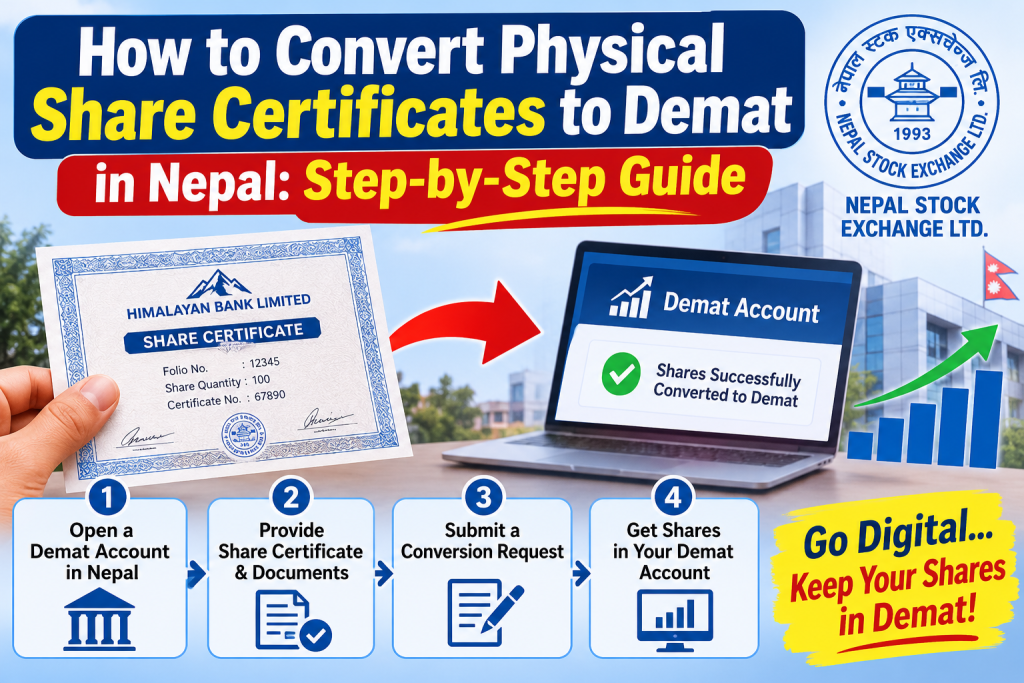
Step-by-Step Guide: How to Convert Physical Shares to Demat
The conversion process requires close coordination between the share owner, their Depository Participant (DP), and the issuer’s Registrar to Shares (RTS) or Issue Manager. Follow these steps sequentially:
Step 1: Identify the Issuer Company’s Registrar to Shares (RTS)
Every listed company in Nepal appoints a Capital Market Firm (Merchant Bank) to act as its Share Registrar (RTS). For example, Nabil Investment Banking, Capital Merchant, NIBL Ace Capital, Global IME Capital, etc., manage share registers for various companies. While you can usually submit your conversion paperwork directly through your DP, knowing the company’s designated RTS helps if you encounter verification discrepancies.
Step 2: Visit Your Depository Participant (DP) Office
Go to the capital division or designated branch of the bank/brokerage firm where your Demat account is hosted. Request a Dematerialization Request Form (DRF). Most DPs provide this form free of charge at their counter, and many DP portals also offer downloadable DRF templates online.
Step 3: Accurately Fill Out the Dematerialization Request Form (DRF)
The DRF is a formal legal application submitted to CDSC to cancel paper records and credit electronic balance. Fill out the form carefully using blue or black ink:
- DP ID and Client ID (BOID): Enter your full 16-digit Demat account number accurately.
- Company Name: Write the full official name of the company whose shares you are converting (e.g., Nepal Telecom, Nabil Bank Limited).
- ISIN (International Securities Identification Number): Each listed share has a unique ISIN code (provided by your DP or listed on the CDSC website).
- Type of Security: Specify whether the shares are Equity Ordinary, Preference, or Debentures.
- Certificate Details: Write down the Folio Number, Certificate Number(s), Distinctive Numbers (From – To), and the total number of physical shares covered by each certificate.
- Signature: Sign the DRF exactly as your signature was recorded when opening your Demat account and original share application.
Step 4: Submit Certificates and Form for Verification
Hand over the filled DRF along with the original physical share certificates, citizenship copy, and photograph to your DP official. The DP officer will verify:
- Physical condition and authenticity of the original certificate.
- Matching investor identity between your BOID and paper certificate.
- Accuracy of distinct numbers against company records.
Once verified, the DP will stamp the original certificates with a “Surrendered for Dematerialization” watermark, provide you with an acknowledgment receipt/copy of the DRF, and enter the request into the CDSC system.
Step 5: RTS Processing and CDSC Electronic Credit
Your DP dispatches the physical certificates and DRF to the issuing company’s Registrar to Shares (RTS). The RTS cross-checks the physical certificate details against their master share register. Upon verification:
- The RTS approves the request in the central CDSC system.
- The physical paper certificates are permanently canceled in company records.
- CDSC authorizes the electronic credit of shares into your DP account.
Step 6: Confirm Shares on MeroShare
Once approved, the credited shares appear in your online portfolio. Log into your MeroShare account, navigate to the My Share or Total Holdings tab, and verify that the holdings reflect correctly under your Free Balance.
Note: If the shares appear locked or under processing, review our guide on how to unfreeze shares in Mero Share to understand standard lock-in rules or administrative balance holds.
What Happens to Unclaimed Bonus Shares & Historical Cash Dividends?
A frequent concern among investors holding physical certificates from 10 or 15 years ago is what happens to accumulate historical bonus shares and unclaimed cash dividends.
When you convert your main physical certificate into Demat, the RTS cross-references your master folio record. If the company declared bonus shares over previous years that were never collected in physical paper form:
- The RTS automatically pools accumulated bonus shares matching your folio and credits them along with your main certificate demat request.
- Uncollected physical dividend warrants issued in past years can be revalidated by visiting the RTS office directly. After presenting proof of Demat conversion and bank details, the RTS will clear pending dividend balances via bank transfer or fresh account payment.
Handling Common Conversion Issues and Obstacles
The conversion process is straightforward when records align perfectly, but older share records often present minor administrative complications. Here is how to resolve them:
1. Signature Mismatch
If your signature has changed over time and does not match the specimen signature stored in the company’s original RTS register, the RTS will reject the DRF. To fix this, visit the RTS office in person with your original Nepalese citizenship certificate, complete a signature verification form, and execute a fresh specimen signature witnessed by bank or capital officials.
2. Name Spelling Discrepancy
Minor spelling variations in names (for instance, “Ram Prasad Sharma” on citizenship vs. “Ram P. Sharma” on old paper certificates) are common. In such cases, your DP or RTS may request:
- An official letter of verification/recommendation from your local ward office (Woda Karyalaya) confirming both names belong to the same individual.
- A formal indemnity bond or self-declaration affidavit notarized legally.
3. Lost Original Share Certificate
If you own shares according to company records but have misplaced the paper certificate, dematerialization cannot proceed directly via DRF. Instead, you must follow the duplicate certificate process:
- File a police loss report at the nearest Nepal Police station.
- Submit an application for duplicate shares to the company’s RTS along with the police report copy.
- Publish a public notice regarding lost certificates in a national daily newspaper (if required by the company’s regulatory bylaws).
- Once the RTS issues a duplicate record or clearance certificate, submit your DRF for dematting.
4. Inheritance/Transmission of Deceased Family Member’s Physical Shares
If the physical share certificate belongs to a deceased family member, the legal heirs must first complete the Share Transmission (Naamsari) process. This requires submitting death certificates, relationship verification certificates (Nata Certified), legal heir consensus letters, and citizenship copies to the RTS. Once the physical shares are legally transferred to the heir’s name, they can be dematerialized into the heir’s personal BOID.
Timeline and Processing Fees
Converting physical shares into electronic Demat form involves practical processing schedules and nominal charges:
- Expected Timeline: Dematerialization typically takes between 7 to 21 working days from the date of DRF submission to your DP, depending on the response speed of the specific RTS office and physical logistics.
- Service Fees: DPs and RTS institutions charge minimal fees for processing physical certificate cancellations and handling forms. Because processing tariffs and postage charges can vary across institutions, investors are advised to check current fee schedules directly with their Depository Participant or the issuing company’s RTS.
Calculating Cost Basis After Demat Conversion
Once your physical share certificates are successfully converted to Demat and credited to your BOID, you are free to sell them on NEPSE via your broker’s TMS portal. However, before selling, you must declare your purchase cost using the Weighted Average Cost of Capital (WACC) module inside MeroShare.
Properly updating your acquisition cost ensures accurate Capital Gains Tax (CGT) calculation upon sale. To understand CGT slabs and rates applicable in Nepal, check our detailed overview on Capital Gains Tax on shares in Nepal. For a step-by-step walkthrough on declaring your purchase price electronically, refer to our guide on how to calculate WACC in Mero Share.
Summary of the Conversion Process
Converting your legacy physical share certificates into Demat format is a crucial step to safeguard your holdings, collect accumulated corporate benefits, and freely trade on the Nepal Stock Exchange. Rather than letting paper certificates sit idle in drawers, locate your original documents, match your identity details, and visit your Depository Participant counter to initiate the DRF process today.
Frequently Asked Questions (FAQs)
1. Can I sell my physical share certificates directly through a stockbroker in Nepal?
No. NEPSE operates entirely on an electronic depository settlement framework managed by CDSC. Stockbrokers cannot execute trades for paper certificates. You must first convert your physical shares into digital Demat form before placing any sell orders on TMS.
2. Can I dematerialize physical shares into someone else’s Demat account?
No. Physical share certificates can only be dematerialized into a Demat account (BOID) where the account primary owner’s name and identity details match the name printed on the physical share certificate. If ownership needs to change due to sales or transfers, official transfer or transmission procedures must be completed with the RTS first.
3. What is a DRF form, and where can I obtain it?
A DRF stands for Dematerialization Request Form. It is an official paper application required by CDSC to initiate the electronic conversion of physical share certificates. You can obtain a blank DRF form directly at the counter of your Depository Participant (bank or broker) or download it from your DP’s official website.
4. How long does it take for physical shares to show up in MeroShare after submitting DRF?
The complete process generally takes anywhere from 7 to 21 working days. The duration depends on physical verification times, document transit between your DP and the company’s Registrar to Shares (RTS), and system entry into CDSC.
5. What happens if my physical share certificate is damaged or torn?
If the essential details—such as the company name, folio number, certificate number, distinct numbers, owner name, and authorized signature stamp—remain clearly legible, DPs typically accept damaged certificates alongside the DRF. However, if critical details are unreadable, you must request a duplicate certificate from the issuing company’s RTS before dematting.
6. Will I lose my uncollected bonus shares if I dematerialize my original primary certificate?
No, you will not lose them. When the RTS verifies your main paper share certificate against their master shareholder database, they will verify all accumulated unissued bonus shares associated with your folio number. The total consolidated share balance will be credited directly to your Demat account.