Selling shares on the Nepal Stock Exchange (NEPSE) through your Trade Management System (TMS) portal is straightforward. However, concluding a successful trade does not stop when your sell order matches on the floor. In Nepal’s dematerialized market, every investor is legally required to hand over sold securities through the Electronic Debit Instruction Slip (EDIS) via their Mero Share account.
Forgetting to perform this transfer on time results in a severe financial shock: the 20% closeout penalty. Retail investors, particularly beginners unaware of strict clearing cycles, frequently see large sums deducted from their broker accounts due to missed deadlines or system errors. Here is a definitive guide explaining how EDIS penalties work, exact settlement timelines, fine calculation examples, and how to safeguard your trading profits.
What is EDIS Failure and the 20% Closeout Penalty in NEPSE?
When you trade equities via NEPSE TMS, you enter a legally binding contract to deliver the sold volume to the buyer. CDS and Clearing Limited (CDSC) manages the clearinghouse mechanics that transfer shares from the seller’s Demat account to the buyer’s Demat account against cash settlement.
Because retail traders handle their own digital transfers, CDSC mandates using EDIS to electronically authorize moving shares out of your depository participant (DP) custody. If you fail to approve this transfer before clearing deadlines expire, an EDIS Failure occurs. As a result, the clearinghouse encounters a short delivery: the buyer paid cash, but the system received zero shares to credit to their account.
Because Nepal does not currently operate an automated physical auction market for retail settlement defaults, the clearing system initiates a mandatory Closeout (Auction/Settlement default) procedure. Under CDS and Clearing regulations approved by the Securities Board of Nepal (SEBON):
- The original transaction is cancelled (closed out in cash).
- The defaulting seller is penalized a flat 20% penalty based on the total transaction amount of the un-transferred shares.
- The buyer receives their original invested capital back, along with the penalty amount (net of statutory deductions), as compensation for missing out on the purchased asset.
- The seller retains the physical shares in their Demat account, but loses 20% in pure cash fine deducted directly by their stockbroker.
Exact Timeline for Mero Share EDIS Submission (T+1 Settlement Rules)
NEPSE operates on a T+2 rolling settlement cycle for complete funds and shares delivery, but the operational window for individual sellers to submit their EDIS instruction is much narrower: T+1 settlement timeline.
Understanding these calendar days prevents unnecessary panic and unexpected fines:
- Trading Day (T): You execute a sell order on TMS during market hours (11:00 AM to 3:00 PM). The trade gets executed. While EDIS occasionally appears in Mero Share late in the afternoon on Day T, CDSC generally updates settlement files after evening batch processing.
- Clearing Day (T+1): This is your crucial legal delivery window. You must log in to Mero Share, calculate and confirm your holding period, update your purchase cost, and authorize EDIS. Most brokerage firms specify an internal operational cut-off between 5:00 PM and 7:00 PM on T+1 to consolidate clearing batches before sending files to CDSC.
- Settlement Day (T+2): CDSC clears and settles the transactions. If your transfer was not posted on T+1, the clearing engine marks your trade as a delivery short, triggering automatic closeout processing.
Note on Holidays: Trading days strictly count days when NEPSE clearing is operational. If you sell shares on Thursday, Friday and Saturday are non-clearing days in Nepal. Therefore, your T+1 deadline falls on Sunday evening.
Step-by-Step Breakdown of How the 20% Cash Fine is Calculated
The 20% closeout fine applies directly to the gross settlement value of the shorted trade, not your capital gain or profit margin. Even if you sold shares at a severe loss, the fine remains pegged to the gross transaction value.
To see how harsh this penalty is, consider this practical scenario:
| Parameter | Example Values |
|---|---|
| Company Sold | 500 Units of XYZ Hydropower |
| Executed Sell Price | Rs. 400 per unit |
| Gross Trade Turnover | Rs. 200,000 (500 x Rs. 400) |
| EDIS Status | Missed / Not Submitted |
| Closeout Fine (20%) | Rs. 40,000 (20% of Rs. 200,000) |
| Shares Status | Remain in seller’s Demat |
In this example, the seller does not get paid the Rs. 200,000 because the trade could not be delivered. Instead, the broker issues an invoice requiring the seller to deposit Rs. 40,000 to cover the penalty. If the seller already has pending credit balances from other trades, the broker automatically deducts the fine from that payout.
Out of this 20% fine, the majority compensates the buyer for breach of contract, while government regulatory splits apply depending on prevailing tax and clearing guidelines.
Common Reasons EDIS Fails (WACC Missing, Holding Period, Broker Match Errors)
Many traders do not skip EDIS deliberately. Often, an operational roadblock prevents the request from clearing. Here are the primary reasons EDIS transfers fail in Nepal:
1. Skipping WACC Calculation
Before transferring shares via EDIS, CDSC requires sellers to establish their acquisition costs so taxes can be assessed accurately. If you skip updating your WACC calculation in Mero Share, the system refuses to generate the final transfer slip under the transfer history queue.
2. Unconfirmed Holding Period
To assess appropriate rates for Capital Gains Tax (CGT), you must declare whether your position is short-term (held under 365 days) or long-term (held over 365 days) in the “My Purchase Source” section. If you fail to verify your holding period, EDIS remains inactive for that scrip.
3. Demat Account Mismatch or Multiple DP Accounts
If you trade across multiple brokerages or maintain separate Demat accounts, you must execute the sell order on the exact Demat account linked to that specific broker. Selling through a broker tied to BOID “A” while holding the actual balance in BOID “B” makes it impossible to locate the shares during EDIS verification.
4. Selling Frozen or Locked Shares
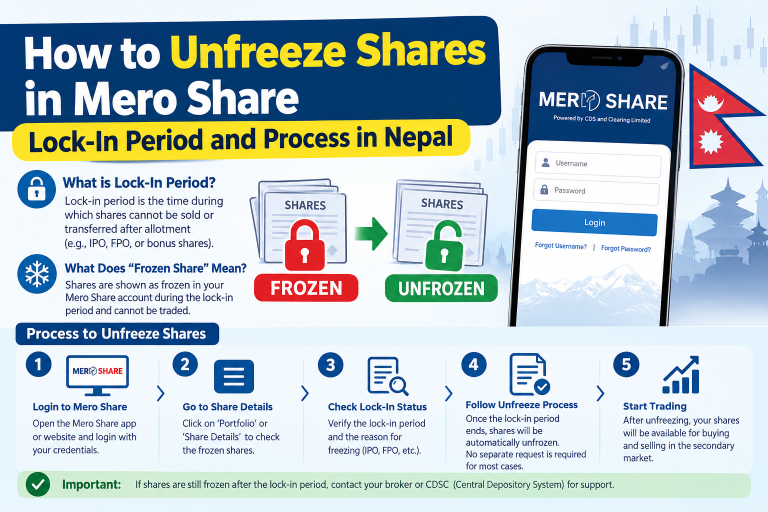
Promoter holdings, lock-in shares from IPO allocations for project-affected locals, or employee quotas cannot be settled on the ordinary market without prior clearance. If you accidentally sell shares still subject to corporate or regulatory lock-in periods, reviewing how to unfreeze shares in Mero Share is critical before trading to prevent settlement collapse.
5. Technical Server Outages at CDSC
During heavy market volatility or major index volume spikes, the Mero Share web server occasionally slows down or displays session errors on T+1 evenings. Leaving your transfer until 6:55 PM leaves you exposed if the login gateway faces intermittent downtime.
What to Do If You Missed the EDIS Deadline: Can You Cancel the Fine?
A widespread question among retail investors is whether a closeout fine can be waived or appealed. Under current CDSC and NEPSE regulations, the 20% closeout fine is automated and cannot be reversed or cancelled once the clearing batch runs on T+2.
However, if you notice an issue before the final clearing cut-off, take these steps immediately:
- Contact Your Broker Settlement Department Immediately: If Mero Share throws a technical database error on T+1 afternoon, capture timestamped screenshots of the error. Call your broker’s settlement desk before 5:00 PM. In certain technical circumstances, brokers can execute a manual pull instruction if you issue a formal, written clearance request in time.
- Verify Free Demat Balances: Ensure the required quantity of shares is unpledged and marked as “Free Balance” rather than frozen collateral against margin loans.
- Check If Closeout Settled: If the deadline has already passed and the closeout is executed, request the official clearing summary ledger from your broker. Ensure the fine calculation matches exactly 20% of your gross trade value, and check that no additional unauthorized debit was posted to your account.
Best Practices to Ensure Timely Share Transfer After Selling on TMS
Avoiding closeout penalties requires discipline and a consistent post-trade workflow. Follow these operational rules every time you exit a position:
- Follow the Standard Transfer Workflow: Always complete your transfer in sequence. Review our comprehensive walkthrough on how to transfer shares using Mero Share EDIS to ensure every sub-step—from purchase source verification to final OTP confirmation—is executed cleanly.
- Never Delay Until T+1 Night: Make it a habit to log into Mero Share by 7:00 PM on the day of the sale (T) or by 10:00 AM on the following morning (T+1). Handling transfers early eliminates stress caused by unexpected internet failures or system downtime.
- Track Transfer Status Under “Transfer Shares”: After entering your security transaction pin or OTP, do not close your browser right away. Open the “Transfer History” tab to confirm that the transfer state is marked as Requested or Settled rather than Pending.
- Reconcile Portfolio Holdings: Check your Demat portfolio after the settlement cycle finishes to verify that the sold units have been deducted and your remaining balances are correct.
Conclusion
The 20% closeout penalty on NEPSE exists to enforce discipline and ensure buyers receive what they paid for. However, for retail investors, forfeiting one-fifth of an entire trade’s gross value due to a forgotten click is an expensive lesson. By understanding the strict T+1 evening cut-off, updating your WACC immediately after selling, and verifying EDIS clearance every single time, you protect your capital and maintain a smooth, trouble-free trading record.
Frequently Asked Questions (FAQs)
What is the deadline to complete EDIS in Mero Share after selling shares?
The standard deadline to finish EDIS is the evening of T+1 (one trading day after the trade execution date). While individual brokers set internal operational cut-offs between 5:00 PM and 7:00 PM on T+1 to compile clearing reports, completing your transfer early during normal business hours is the safest way to avoid technical delays.
How much is the closeout fine if EDIS is not completed on time?
Under NEPSE and CDSC clearing rules, the default fine is exactly 20% of the total transaction amount of the undelivered shares. The fine is based on the gross selling value, not on your net profit.
Does the 20% closeout fine go to the stockbroker or the buyer?
The stockbroker does not retain the closeout penalty. The bulk of the penalty is credited directly to the buyer whose purchase could not be delivered, serving as legal compensation for the cancelled trade. A portion may also be subject to regulatory handling fees and government taxes according to clearinghouse guidelines.
Can a broker execute EDIS on my behalf if I have technical issues?
Brokers cannot routinely access your private Mero Share account. However, if there is a documented system failure or you provide a signed physical or digital debit instruction slip (DIS) before the clearing deadline, your broker’s settlement department may process the delivery directly through depository participant clearing tools.
Do I lose my shares if closeout occurs?
No. If a trade goes into closeout, you do not lose your original shares because the transfer never happened. The shares remain inside your Demat account, free to be held or sold again in the future. However, you must still pay the 20% cash penalty for defaulting on the transaction contract.