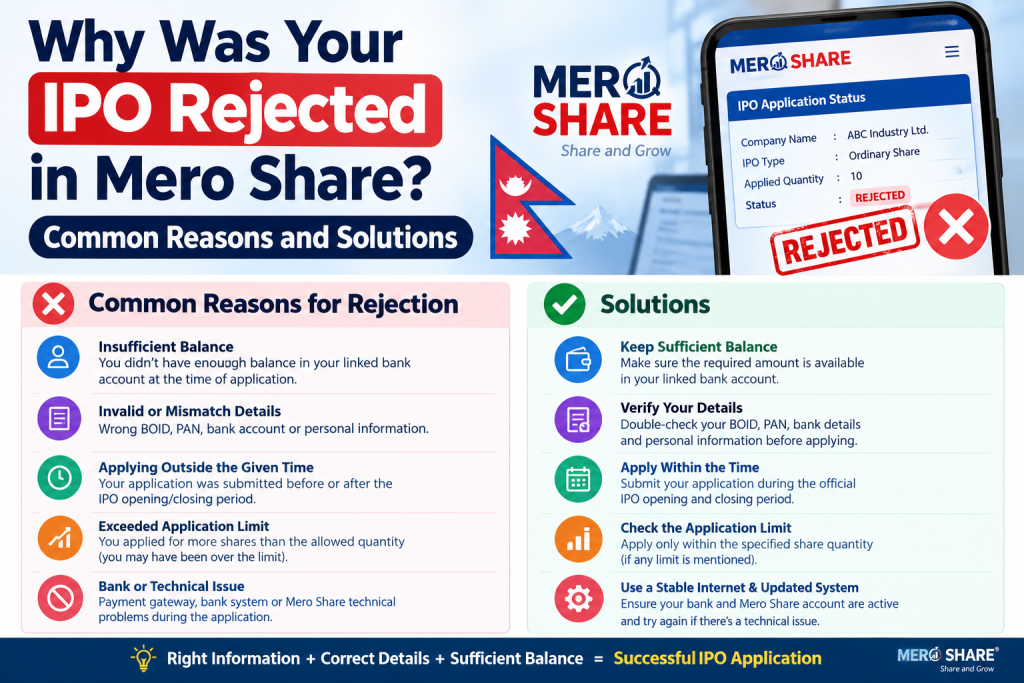
Applying for an Initial Public Offering (IPO) in Nepal has become simple thanks to the Central Depository Services and Clearing Limited (CDSC) portal, Mero Share. With a few clicks, retail investors can apply for shares in hydropower companies, microfinances, insurance companies, and commercial banks right from their phones. However, few things are as frustrating as logging in to inspect your application report only to discover that your status has changed to a bright red Rejected label.
When an application is rejected, Mero Share rarely displays an extensive explanation on the dashboard. This leaves many beginner investors wondering what went wrong, whether their money is gone, and if they can still participate in the offering. In this comprehensive troubleshooting guide, we break down why your IPO application was rejected in Mero Share, what happens to your funds, and the exact steps you can take to prevent or resolve these errors.
Understanding Mero Share IPO Application Statuses
When you submit an application under the Apply for Issue tab in Mero Share, your request does not immediately go to the issue manager for share allotment. It first passes through the C-ASBA (Centralized Applications Supported by Blocked Amount) banking system. You can track this lifecycle under the Application Report tab:
- Unverified: This is the initial status immediately after you enter your CRN number and submit your application. It indicates that Mero Share has forwarded your application details to your chosen bank, but the bank’s automated clearing system or manual verification team has not yet processed the lien (blocking of funds).
- Verified: This means your bank has successfully checked your account details, confirmed sufficient funds, and placed a temporary hold (lien) on the application sum. A “Verified” status guarantees that your application will be forwarded to the issue manager and included in the IPO allotment lottery.
- Rejected: This status indicates that either your commercial/development bank or the issue manager canceled your application. An application with “Rejected” status is excluded from the allotment lottery, meaning you have zero chance of receiving shares for that issue.
Top Reasons Why IPO Applications Get Rejected in Mero Share
C-ASBA rejections stem from specific regulatory, banking, or technical requirements. Below are the most frequent reasons retail investors face IPO rejections in Nepal.
1. Insufficient Bank Balance or Lien Placement Failure
By far, the most common reason for IPO rejection in Nepal is inadequate available balance at the exact moment the bank processes your application. When you apply for 10 kitta of an IPO at the standard face value of NPR 100 per share, you need NPR 1,000. However, having exactly NPR 1,000 in your account balance may not be enough:
- Minimum Balance Requirements: Many bank accounts require an untouchable minimum operating balance (for example, NPR 500 or NPR 1,000). If your total balance is NPR 1,200 and the required minimum account balance is NPR 500, your free “available balance” is only NPR 700. The bank cannot place a lien on NPR 1,000 without breaching your minimum balance threshold, triggering an automatic rejection.
- C-ASBA Service Fees: While several financial institutions offer free C-ASBA registration, some banks charge a regulatory C-ASBA fee (up to the SEBON-capped maximum of NPR 5 per application). Make sure to check your institution on the C-ASBA charge bank-wise fee list. If your account holds exactly NPR 1,000 and the bank attempts to deduct its NPR 5 processing fee alongside the application amount, the transaction will fail.
2. Account Information Mismatch: Demat Name vs. Bank Account Name
Under regulations enforced by the Securities Board of Nepal (SEBON) and CDSC, the primary applicant details must match across all linked financial accounts. The name registered on your Demat account (managed by your Depository Participant) must match the name registered on your bank account.
Common mismatches occur due to:
- Spelling variations or typographical errors in your citizenship card.
- Inclusion or omission of middle names (e.g., “Ram Kumar Shrestha” in Demat vs. “Ram Shrestha” in the bank).
- Attempting to apply using a bank account belonging to a family member (such as a spouse or parent) on an individual Demat account. Every individual investor must use their own personal bank account linked to their specific Demat account, except in legitimate minor accounts managed by a legal guardian.
3. Unverified C-ASBA Setup or Invalid Bank Account Linking
Applying for an IPO requires your bank to map your 16-digit Beneficiary Owner Identification Number (BOID) to their core banking platform via the C-ASBA registration process. Your application might be rejected if:
- You entered an incorrect or expired CRN number.
- The bank account linked to Mero Share has become dormant due to lack of transactions (dormant accounts cannot have liens placed on them).
- Your bank KYC (Know Your Customer) update has expired, leading the bank’s automated compliance system to freeze automated debits and lien operations.
4. Duplicate Application Submissions Across Quotas
SEBON regulations strictly prohibit duplicate primary market applications from the same individual. An application will face instant rejection by the issue manager if:
- You submitted an application under the local project-affected quota and then submitted another application under the general public quota using the same citizenship or National Identity details when duplicate restrictions apply.
- You applied for the foreign employment quota (for Nepalese working abroad with remittance accounts) and subsequently placed another bid in the general category.
- You hold multiple Demat accounts and submitted applications from more than one account for the same company issue. Under CDSC rules, an investor is strictly permitted only one valid application per IPO issue.
5. Expired Demat or Mero Share Account Validity
Every Demat account in Nepal requires an annual renewal fee of NPR 100, and Mero Share requires an annual fee of NPR 50, payable to your Depository Participant (DP). If you forget to renew your Mero Share and Demat account by the end of Ashad (the Nepali fiscal year-end), your DP may restrict debit and credit operations on your account. When the C-ASBA system attempts to validate your account status with the depository, an expired profile can result in verification refusal.
What Happens to Your Blocked Money When an IPO Application Is Rejected?
One of the biggest concerns among beginners is financial loss: “Did the bank take my money? Will I get a refund?”
It is important to remember how C-ASBA works. When you apply for an IPO, your money never leaves your bank account. Instead, the bank simply places a lien (a software freeze) on the specified sum. You still earn interest on the blocked balance in standard savings accounts according to bank guidelines.
If your application status changes to “Rejected”:
- If the lien was never placed (e.g., due to low balance or account mismatch), no money was ever locked. Your existing balance remains completely untouched.
- If the lien was temporarily placed but rejected later by the issue manager, the bank’s system automatically releases the lien once the rejection batch file is synchronized from CDSC. This usually occurs within 24 to 48 banking hours. Once released, the funds are immediately available for normal withdrawals.
Step-by-Step Fixes: How to Edit and Reapply Before the IPO Issue Deadline
If you catch a “Rejected” status while the public issue is still open, you do not have to miss out on the allotment. Follow these steps to correct the problem and resubmit:
- Identify the Rejection Reason: Go to Mero Share, navigate to Asba > Application Report, and click on Report next to the rejected company. Check the “Remarks” field. Banks frequently write short notes such as “Insufficient Balance,” “Name Mismatch,” or “KYC Pending.”
- Address the Core Problem:
- If the issue was balance: Transfer adequate funds into the account immediately via connectIPS, mobile banking, or digital wallets, accounting for minimum balances and C-ASBA fees.
- If the issue was KYC or CRN: Contact your bank branch or customer support hotline to unfreeze dormant accounts or update expired KYC records.
- If your Demat expired: Pay the annual renewal fee online via eSewa, Khalti, or connectIPS.
- Reapply or Edit in Mero Share: If the issue window is still active, you will see an Edit button or you may be permitted to submit a fresh application under Apply for Issue. Enter your required kitta, choose your bank, enter your valid CRN, and submit your 4-digit transaction PIN.
- Monitor for Verification: Check back several hours later (or early the next morning) to confirm that the status updates from “Unverified” to “Verified.”
Note: If the IPO deadline has already passed (usually 5:00 PM on the closing date), you cannot reapply for that specific issue. However, fixing the underlying issue right away ensures your application for the next upcoming primary issue will proceed smoothly.
Pre-Application Checklist to Guarantee Successful IPO Verification
Before submitting your next bid when applying for an IPO via Mero Share, run through this quick checklist:
| Verification Item | What to Confirm |
|---|---|
| Available Balance | Ensure your account has the application amount PLUS the bank’s minimum balance requirement and C-ASBA processing fee. |
| CRN & Bank Details | Verify that the bank account selected in the dropdown matches your active CRN registration. |
| Demat & Mero Share Expiry | Check the profile section in Mero Share to ensure your account validity extends beyond the current date. |
| KYC & Account Status | Confirm your bank account is active, has had a recent transaction, and does not have an expired KYC flag. |
| Single Application Rule | Apply only once per individual BOID. Do not submit duplicate bids across multiple categories or secondary accounts. |
Conclusion
Seeing a “Rejected” status on your Mero Share IPO application is discouraging, but in almost every situation, it is caused by easily preventable issues like low available balances, expired Demat renewals, or unverified bank links. By understanding how the C-ASBA verification workflow operates and reviewing your account status before pressing submit, you can safeguard your application and ensure your entry into every public offering lottery.
Once your application reaches “Verified” status, all that remains is to await the official allotment date. When the lottery concludes, you can easily verify whether you were allotted shares by using an online IPO allotment result checking guide.
Frequently Asked Questions (FAQs)
Why does my Mero Share IPO application show ‘Rejected’ status?
Your application displays ‘Rejected’ because either your bank or the issue manager declined it during verification. The most common reasons are an insufficient bank balance (after accounting for minimum balances and C-ASBA fees), an expired Demat account, an invalid or dormant bank account, or a name mismatch between your bank and Demat records.
Does an IPO rejection mean my blocked money is lost?
No. Your funds are never lost. Under Nepal’s C-ASBA system, money remains in your personal bank account under a temporary hold (lien). If your application is rejected, no money is deducted, and any existing lien is automatically released by the bank.
Can I edit and resubmit my IPO application in Mero Share after it is rejected?
Yes, provided the IPO issue is still open for public subscription. You can resolve the underlying cause (such as depositing more funds or clearing a KYC block) and click “Edit” or resubmit your application under the ASBA section before the daily issue closing deadline.
How long does the bank take to unfreeze money after an IPO rejection in Nepal?
In most commercial and development banks, a lien is released automatically within 24 to 48 banking hours after the rejection status is processed by CDSC. If your money remains blocked beyond two business days, contact your bank’s C-ASBA customer support desk with your BOID and application report details.
Why was my IPO rejected even though I had sufficient bank balance?
Even if your total account balance looks sufficient, the rejection may occur if your “free available balance” was lower than required due to your bank’s mandatory minimum operating balance. Additionally, rejections happen if the bank account is dormant, your bank KYC has expired, your Demat renewal fee has lapsed, or there is a spelling discrepancy between your bank and Demat profile.