In Nepal’s growing stock market, starting early is one of the smartest financial decisions a parent or guardian can make. With the retail primary market (IPO) booming across sectors like hydropower, banking, and insurance, opening a Demat and MeroShare account for your child allows you to secure shares at par value (usually Rs. 100 per share) and build a long-term investment portfolio.
While many adults are already active in the stock market, managing share investments for children under 16 requires a specific legal procedure. In this step-by-step guide, you will learn everything about opening a minor Demat account in Nepal, preparing the required KYC documents, getting a MeroShare login and CRN number, applying for IPOs, and converting the account when your child reaches adulthood.
What is a Minor Demat Account and Who Can Open It?
A Minor Demat Account is an electronic securities account registered in the name of an individual who is under 16 years of age (the legal threshold for minor status in financial market documentation in Nepal). Just like a standard Demat account managed under Central Depository Services and Clearing Ltd. (CDSC), it holds shares, mutual funds, and debentures in digital format.
Because minors cannot legally sign contracts or execute financial trades independently, a minor Demat account must be operated by an authorized legal guardian. The legal guardian can be:
- Father or Mother: The primary natural guardians.
- Legal Court-Appointed Guardian: In special circumstances where parents are unavailable or deceased, a legal guardian authorized by court documentation can manage the account.
The child remains the sole legal owner of all securities held in the account, while the legal guardian holds operational authority until the child reaches adulthood.
Key Benefits of Opening a Demat and MeroShare Account for Minors
Starting an investment journey for your child offers several distinct strategic and financial advantages:
1. Equal IPO Allotment Advantage
In Nepal, SEBON’s 10-unit allotment rule applies equally to all valid applicants, regardless of age. By maintaining Demat accounts for all family members—including children—your household increases its overall probability of receiving IPO share allotments in heavily oversubscribed public issues.
2. Compounding Wealth Over Time
When you participate in upcoming IPOs in Nepal on behalf of a child, those shares have 10 to 18 years to appreciate before the child reaches adulthood. Bonus shares, cash dividends, and rights issues accumulated over this horizon can form a substantial fund for higher education or early financial security.
3. Financial Literacy
Involving your child in dividend collection, portfolio tracking, and long-term saving builds practical financial discipline from an early age, preparing them to handle money responsibly as adults.
Required Documents for Minor Demat and C-ASBA Registration
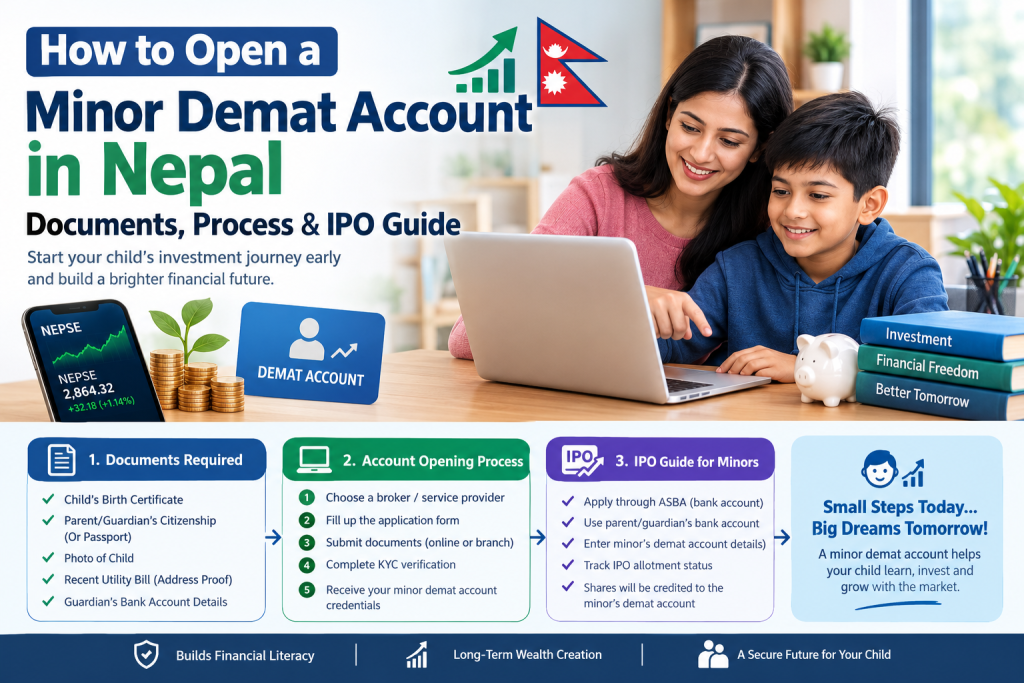
Before visiting a Depository Participant (DP)—such as a commercial bank’s capital wing or a licensed stockbroker—ensure you have all necessary original documents and photocopies ready. Missing paperwork is the most common reason for application rejection.
| Document Type | Details & Requirements |
|---|---|
| Child’s Identification | Official Birth Certificate issued by the local Ward Office (Janma Darta) or valid Passport. |
| Guardian’s Identification | Original Nepali Citizenship Certificate (Nagarikta) of the father, mother, or legal guardian. |
| Child’s Bank Account | A minor bank account held in the child’s name (linked with the guardian) at a C-ASBA participating bank. |
| Passport-Size Photographs | Recent passport-size photos of the minor (2-3 copies) and the guardian (2-3 copies). |
| KYC Details | Complete address details, guardian’s PAN (optional but recommended), and signature verification. |
Note: If the guardian’s surname differs from the child’s due to marriage or legal updates, additional relationship verification documents from the Ward Office may be requested by the DP.
Step-by-Step Guide to Opening a Minor Demat Account (Online and In-Branch)
You can open a minor Demat account either by visiting the branch of a Capital/Broker or using their online KYC submission portals.
Method 1: In-Branch Application (Recommended for First-Timers)
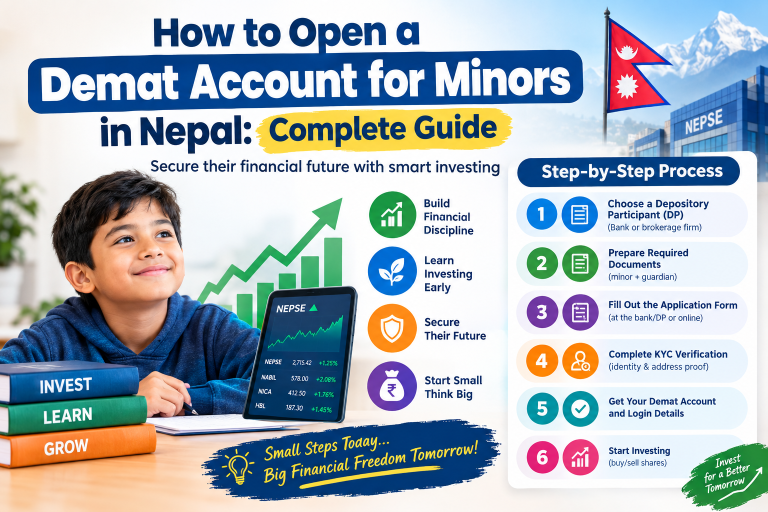
- Choose a Depository Participant (DP): Select a DP registered with CDSC. This can be your preferred commercial bank’s capital subsidiary (e.g., Nabil Capital, Global IME Capital) or an authorized NEPSE stockbroker.
- Collect the Demat & MeroShare Application Forms: Ask for the Minor Demat Account Opening Form and MeroShare Registration Form.
- Fill Guardian & Minor Details: Enter the minor’s personal details carefully, matching the birth certificate exactly. Fill in the guardian section with full citizenship details.
- Attach Documents & Photos: Paste photos in designated areas and sign where marked for the guardian. The minor’s thumb Impression (right and left) may be taken on the form.
- Submit and Pay Opening Fees: The standard DP account opening fee in Nepal is Rs. 50 for Demat setup and Rs. 50 for MeroShare registration (rates are set by regulation, though specific bank processing charges may vary slightly).
- Receive BOID: Within 1 to 3 working days, you will receive a 16-digit Beneficiary Owner Identification Number (BOID) via SMS or email.
Method 2: Online Application
If you prefer digital submission, many DPs offer an online portal. For detailed guidance on general online Demat registration, see our guide on how to open a Demat account online in Nepal. When filling out the form for a minor online, ensure you select the Minor account type so the system opens the additional mandatory fields for Guardian Citizenship and Ward Birth Certificate uploads.
Getting MeroShare and CRN Number for a Minor
Having a Demat account alone does not allow you to apply for primary market issues online. You also need access to the MeroShare portal and a valid C-ASBA Registration Number (CRN).
1. Activating MeroShare
When filling out the Demat form, check the box for MeroShare registration. Once processed, the DP sends your initial login credentials (Depository Participant Name, Username/BOID, and initial Password) to your registered email address. Log in to MeroShare, set a new password, and create a 4-digit Transaction PIN.
2. Acquiring the CRN Number
To link the minor’s bank account with MeroShare for C-ASBA share applications, follow these steps:
- Open a minor bank account at a C-ASBA participating bank (if you haven’t already).
- Fill out a C-ASBA Registration Form at the bank branch or via the bank’s internet banking portal.
- Provide the minor’s 16-digit BOID and bank account number. The guardian must sign the form verifying authorization.
- The bank verifies the details and provides a unique CRN Number. To understand more about C-ASBA setup, read our detailed guide on getting a CRN number in Nepal.
Rules for Applying for IPOs and Trading Shares on Behalf of Minors
Managing investments for a minor involves specific regulatory guidelines laid out by CDSC and SEBON. Here is what you need to know about buying and selling shares for children:
Applying for IPOs via MeroShare
Applying for an IPO for a minor follows the exact same process as an adult account:
- Log into the minor’s MeroShare portal.
- Navigate to My ASBA → Apply for Issue.
- Select the active public issue (usually 10 units minimum).
- Select the minor’s linked bank, enter the verified CRN number, and submit using the 4-digit PIN.
Make sure the linked bank account has sufficient funds to cover the applied units plus applicable C-ASBA processing fees. You can review the exact bank fees using our C-ASBA charge list for banks in Nepal.
Trading and Selling Shares on NEPSE
While applying for primary IPOs is straightforward, trading on the secondary market (NEPSE) on behalf of a minor requires additional steps:
- Broker Account Setup: Most online Trade Management Systems (TMS) are designed for adult investors with valid Citizenship numbers. To sell a minor’s shares via a broker, the legal guardian must open a TMS profile or visit the stockbroker in person with relationship proof and guardian authorization. For steps on broker setup, check our guide to opening a broker account in Nepal.
- EDIS Transfer: When shares allocated to a minor are sold, the guardian must execute the electronic instruction via MeroShare EDIS. For full steps on executing transfers safely, review how to transfer shares using MeroShare EDIS.
What Happens When the Child Turns 18? (Converting Minor to Major Account)
Once the child reaches legal adulthood (18 years of age in standard civil matters and financial system updates), the guardian’s control over the account legally ends. The account must be officially converted into an adult (Major) Demat account.
Conversion Process Steps:
- Obtain Adult Identification: The individual must obtain an official Nepali Citizenship Certificate (Nagarikta).
- Update Bank Account: Convert the minor bank account to a standard adult savings account at the bank branch by submitting the new citizenship copy, signature, and updated KYC.
- Submit KYC Update at DP Office: Visit the Depository Participant (Capital/Broker) where the Demat account was opened. Fill out the Demat Status Conversion / KYC Update Form.
- Submit Documents: Provide copies of the newly issued Citizenship card, passport-size photos of the newly turned adult, and the original minor Demat verification slip.
- Signature and Biometric Update: The individual will register their official signature and thumbprints directly with the DP, removing the guardian’s signature authority.
After conversion, the individual gains full personal access to their MeroShare, CRN, and independent online broker trading account.
Common Mistakes to Avoid When Managing a Minor Demat Account
- Name Mismatches Across Documents: Ensure the child’s name spelling on the birth certificate matches the minor bank account and Demat KYC form line for line. Even a minor spelling difference can lead to C-ASBA rejection during IPO processing.
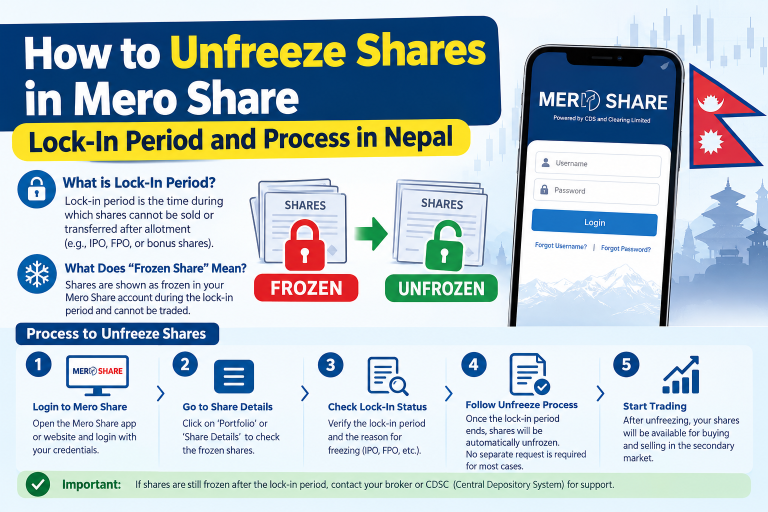
- Neglecting Annual Account Renewals: Demat accounts require an annual renewal fee of Rs. 100, and MeroShare requires Rs. 50. If unpaid, the account status becomes frozen/expired, preventing IPO applications. Keep your account active by learning how to renew MeroShare online.
- Using Parent’s Personal Bank Account: Many parents attempt to link their personal bank account to their child’s Demat account. C-ASBA regulations mandate that the bank account name must match the Demat account holder’s name. Always open a minor bank account for the child first.
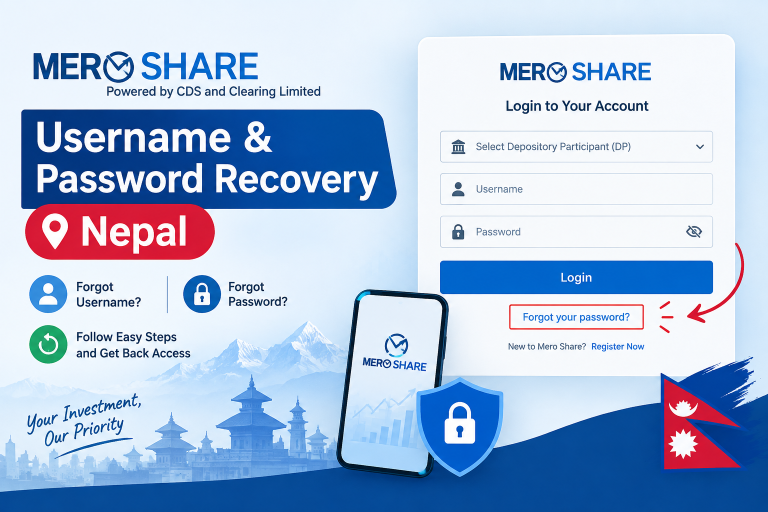
- Forgetting to Keep Track of Credentials: Managing multiple accounts for family members can cause login confusion. Keep strict secure records of usernames, transaction PINs, and bank account details for each child.
Frequently Asked Questions (FAQs)
Can shares allotted to a minor Demat account be sold on NEPSE?
Yes. Shares owned by a minor can be sold on the NEPSE secondary market, but the guardian must execute the trade through a licensed broker or designated online portal, followed by MeroShare EDIS confirmation signed off by the guardian.
How do you convert a minor Demat account into a regular adult Demat account upon turning 18?
When the child turns 18 and receives a Citizenship Certificate, the guardian and the child must visit the DP branch. Submit an updated KYC form along with the new citizenship copy and specimen signatures to convert the status to a major account.
Conclusion
Opening a minor Demat account is a practical way for Nepalese parents to secure primary market share allocations for their children while building long-term wealth over time. By preparing the required birth certificate, minor bank account, and citizenship documents in advance, you can easily complete the registration process with any licensed Depository Participant.
Keep the account active by paying annual renewal fees on time and ensuring that names match perfectly across all banking and investment records. With consistent IPO participation, your child will have a solid financial head start by the time they reach adulthood.