During the massive surge of retail participation in the Nepali capital market, many investors opened multiple Demat accounts across different commercial banks, merchant capital firms, and stockbrokers. Whenever a new bank introduced easy digital onboarding, investors rushed to create accounts to test platform speeds or secure IPO quotas. However, managing multiple accounts often leads to overlooked annual maintenance charges, frozen accounts, and administrative complications.
Under regulations enforced by the Securities Board of Nepal (SEBON) and CDS and Clearing Limited (CDSC), individual investors are permitted to hold a maximum of two Demat accounts. If you have excess, inactive, or duplicate accounts, consolidating your portfolio and closing unused accounts is essential. This guide walks you through why this rule exists, how to transfer your shares from one Depository Participant (DP) to another, and the exact steps to close an unwanted Demat account in Nepal.
Why You Might Need to Close or Transfer a Demat Account in Nepal
Holding multiple Demat accounts might seem harmless initially, but keeping inactive accounts open presents practical challenges:
- Recurring Annual Renewal Fees: Every Demat account in Nepal incurs an annual maintenance fee of NPR 100 per fiscal year. In addition, an associated MeroShare account costs NPR 50 annually. If you hold three or four neglected accounts, you accumulate unnecessary unpaid dues year after year.
- Account Freezing by CDSC: CDSC routinely audits national investor databases using Citizenship and PAN details. Investors found holding more than two active Demat accounts risk automated freezes, which can lock your MeroShare portal and block secondary market trading or IPO applications.
- Scattered Investment Records: Tracking dividends, rights issues, and bonus share distributions across multiple Beneficiary Owner Identifications (BOIDs) creates confusion during portfolio rebalancing and tax filings.
- Switching to a Preferred DP: Many investors initially opened accounts at bank branches that lack responsive customer service. Transferring your holdings to a dedicated merchant capital firm or broker-affiliated DP provides smoother coordination with your broker account online.
SEBON Rules: Understanding the 2-Demat Account Limit in NEPSE
To eliminate market manipulation, prevent speculative multiple filings during primary market subscriptions, and maintain transparency, SEBON issued a clear directive limiting every natural individual citizen of Nepal to a maximum of two Demat accounts.
Here is what the regulatory framework entails:
- The Two-Account Rule: A retail investor can legally operate up to two Demat accounts at any given time (for instance, one linked to a commercial bank DP for long-term investments and another linked to a broker DP for active swing trading).
- Impact on Minors: Even in the case of a Demat account for minors, parents or guardians must adhere to strict depository rules, ensuring the child’s identity records do not violate CDSC limits.
- Automated Rejection: If you attempt to open a third Demat account, the CDSC centralized depository system flags the existing duplicate KYC details, prompting the issuing DP to reject your new application until an existing account is permanently deactivated.
Prerequisites Before Closing Your Demat Account
You cannot simply submit a closure letter and walk away. A Demat account holds legal custody of financial assets, meaning specific clearance criteria must be met before your DP accepts the closure petition.
- Zero Share Balance: The account must hold exactly zero securities. You cannot close a Demat account that contains listed equities, mutual fund units, corporate debentures, or unlisted promoter shares. You must either liquidate them on the secondary market or initiate a formal DP-to-DP transfer.
- Pending Corporate Actions & Allotments: Ensure no incoming bonus shares, cash dividends, or IPO allotments are pending. If you recently applied for an IPO or right share using that BOID, wait until the issue closes, allotment concludes, and shares credit to your account before proceeding.
- Clear All Outstanding Dues: If your account has been dormant for several years, calculate your accumulated annual fees. You must clear these pending fees before your DP will process the request. You can check your status and renew Mero Share account online via digital wallets like eSewa, Khalti, or ConnectIPS.
- Release Any Pledges or Liens (Rokka): If any shares in the account were pledged as collateral for a bank margin loan or frozen due to a court or tax authority directive, the bank or authority must issue an official release letter to the DP beforehand.
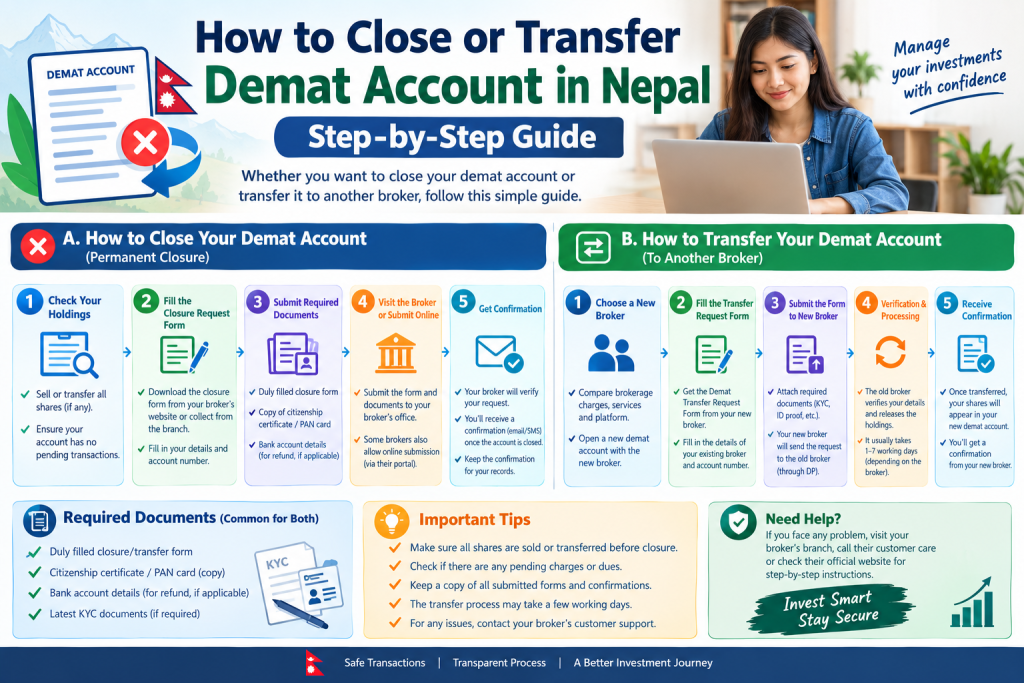
How to Transfer Shares to Another Demat Account (DP Transfer Process)
If you have existing shares in a Demat account that you wish to decommission, you do not have to sell them and pay broker commissions or capital gains tax. Instead, you can transfer your entire shareholding to your other active Demat account under the same name. This procedure is called an Inter-DP Share Transfer or Consolidation Transfer.
Here is how the DP transfer process works:
Step 1: Obtain the CDSC Transfer / Delivery Instruction Slip (DIS)
Visit your current Depository Participant (the source DP where your shares are held). Request a Delivery Instruction Slip (DIS) booklet or the official Share Transfer / Portfolio Consolidation Form.
Step 2: Complete the Transfer Form Details
Accurately fill in the mandatory parameters on the form:
- Source BOID: Your 16-digit Demat number from which shares are moving.
- Target (Destination) BOID: The 16-digit Demat number of your second account where shares will arrive. Both accounts must belong to the exact same person with identical citizenship and KYC details.
- Company Name & Script Symbol: Mention the full legal name of each listed company (e.g., Nabil Bank Limited) and trading symbol (e.g., NABIL).
- ISIN Number: The unique International Securities Identification Number assigned to the script (your DP or MeroShare portfolio page provides this).
- Quantity: The exact unit volume of shares being shifted.
Step 3: Pay the CDSC Transfer Fee
Inter-DP share transfers between identical individual ownership accounts carry a small statutory fee set under CDSC bylaws. In most cases, DPs charge between NPR 25 to NPR 50 per script (plus applicable VAT/service charge). Always confirm current service rates with your DP counter.
Step 4: Verification and Settlement
Submit the completed DIS or transfer form alongside a copy of your Citizenship card and Demat confirmation sheets for both BOIDs. Once verified, the source DP executes the transfer through the CDSC central clearing system. The shares usually reflect in your target Demat account within 3 to 7 working days.
Note: If you plan to sell your shares instead of transferring them, you can execute a sell order via your broker’s TMS and safely transfer shares using Mero Share EDIS without manually filing paper slips.
Step-by-Step Guide to Close Your Demat Account (Offline & Online)
Once your account balance is completely zero and all dues are settled, you can execute the final closure.
Method 1: Offline In-Person Closure (Most Reliable)
Because closing a depository account requires identity verification, visiting your DP remains the primary and most dependable method across Nepal.
- Visit Your DP Branch: Go to the merchant banking wing, corporate headquarters, or authorized bank branch of your Depository Participant.
- Request the Demat Account Closure Form: Ask the customer support desk for the Beneficiary Account Closure Application (हितग्राही खाता बन्द गर्ने निवेदन).
- Fill in the Requisite Information:
- 16-digit Beneficiary Owner ID (BOID).
- Full Name, Registered Mobile Number, and Residential Address.
- Reason for closure (e.g., “Exceeding the SEBON 2-account limit” or “Consolidating portfolio into a single DP”).
- Attach Required Documentation: Provide a self-attested photocopy of your original Nepali Citizenship certificate or passport.
- Clear Remaining Arrears: Hand over proof of renewal payments or settle any final balance directly at the cash counter.
- Collect Acknowledgment Receipt: Ensure the officer provides an official stamped receipt or dispatch token confirming your closure request has been lodged.
Method 2: Online Closure Request (Selected DPs Only)
A growing number of tech-forward merchant capital companies (such as Nabil Investment Banking, NIC Asia Capital, or Global IME Capital) accept remote deactivation under specific circumstances:
- Download the official Demat Closure PDF form from your DP’s official website.
- Print, fill out, and physically sign the document.
- Scan the completed form along with your Citizenship card and proof of zero dues (eSewa/ConnectIPS payment vouchers).
- Send the documents from your official registered email address to the DP’s customer care portal or support email.
- The DP will verify your signature against their initial records and initiate closure. They may call your registered mobile number for two-factor verbal authorization.
Always verify whether your specific financial institution supports email-based account deactivation before relying solely on digital submissions.
Demat Account Closure Charges & Settlement of Dues
A frequent point of confusion among beginners is whether banks charge a cancellation fee to close an account. Under standard CDSC directives:
- Account Closure Charge: DPs do not charge an explicit “closure penalty” or cancellation fee. Terminating the account itself is free.
- Past Dues Settlement: If your account has been active or dormant for three fiscal years without paying renewal fees, you must pay the backdated annual fee (NPR 100 × 3 years = NPR 300) before closure is processed.
- MeroShare Portal Fee: Any unpaid MeroShare access fee (NPR 50 per year) tied to that DP must be brought to zero.
- Transfer Expenses: If you moved shares to another account prior to closure, you are responsible for the standard per-script transfer fee (NPR 25–50 per company).
Common Reasons Why Demat Account Closure Requests Get Rejected
If you submitted an application and your BOID remains active after several weeks, your request was likely flagged. The most common reasons include:
| Issue | Why It Happens | How to Resolve |
|---|---|---|
| Fractional Share Units | Bonus share distributions sometimes credit fraction units (e.g., 0.45 shares). Even fractional holdings prevent automated closure. | Contact your DP or company share registrar (RTS) to sell or adjust the odd-lot fractional units. |
| Unsettled IPO Application | An IPO was applied for using C-ASBA where funds or allotments are still under verification. | Wait until the allotment results are finalized and unallotted bank balances are unfrozen. |
| Signature Mismatch | The signature on the closure form does not match the signature on your original account-opening KYC. | Visit the branch in person with your original Citizenship card to update your KYC signature. |
| Active Bank Lien / Margin Loan | The account was once linked to a loan and the lender’s clearance letter was never forwarded to the DP. | Request a formal No Objection Certificate (NOC) / Release Letter (फुकुवा पत्र) from the lending bank. |
| Outstanding Annual Dues | Even a minor unpaid balance of NPR 50 or 100 halts system de-registration. | Pay pending renewal charges through MeroShare or payment partner gateways. |
Final Thoughts
Consolidating your Demat holdings and closing redundant accounts protects you from regulatory freezes, saves money on recurring annual maintenance fees, and streamlines your overall portfolio management. If you are starting fresh with a new DP or looking to setup your accounts properly, explore our detailed guide on how to open Demat account online in Nepal to ensure full compliance right from day one.
Frequently Asked Questions (FAQs)
Is there any government or DP fee for closing a Demat account?
No fee is charged specifically for closing a Demat account in Nepal. However, you must settle all accumulated annual maintenance fees (NPR 100/year for Demat and NPR 50/year for MeroShare) and pay any standard per-script transfer fees if moving holdings to another account.
What happens if I stop renewing an unused Demat account instead of closing it?
If you abandon an unused Demat account without formally closing it, annual maintenance charges (NPR 100/year) continue to accumulate as unpaid debt on your profile. Eventually, CDSC will freeze your associated MeroShare account, which can prevent you from applying for IPOs or trading through your other active accounts.
How long does it take for a Demat account closure to reflect?
Once all prerequisites are met and the paper or digital form is submitted, the DP usually processes the request within 2 to 5 business days. Once finalized, the BOID status changes to “Closed” within the CDSC centralized depository database.
Related guides: open broker account online | Demat account for minors | renew Mero Share account online | transfer shares using Mero Share EDIS | open Demat account online in Nepal