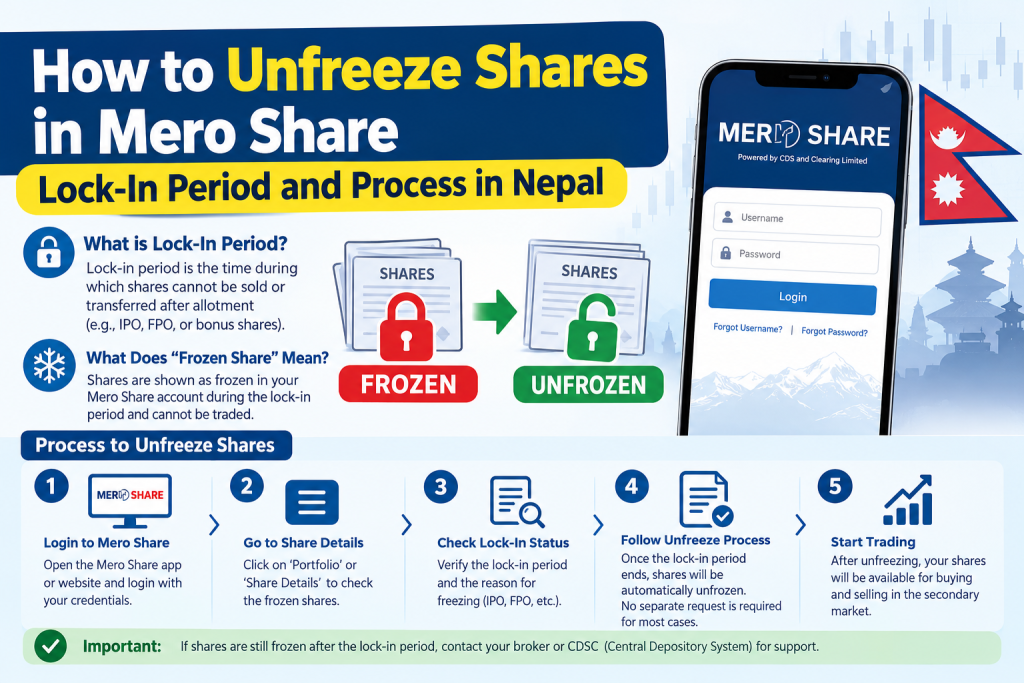
When opening your portfolio on Mero Share, you might notice that some or all of your holdings for a specific company appear under Freeze Balance rather than Free Balance. When shares are marked as frozen, you cannot sell them on the Nepal Stock Exchange (NEPSE) through your broker’s Trade Management System (TMS), nor can you transfer them via EDIS.
While encountering this status can be alarming, it rarely indicates a technical bug or penalty. In Nepal’s capital market, shares are usually frozen because of regulatory lock-in mandates set by the Securities Board of Nepal (SEBON) or corporate pledge conditions. Understanding why your scrips are locked and how to release them ensures you can plan your exit strategies effectively.
What Does Frozen Status Mean in Mero Share Demat Portfolio?
Inside the CDS and Clearing Limited (CDSC) electronic registry, every Demat account tracks securities across specific balance categories:
- Current Balance: The total cumulative units of a company credited to your Beneficiary Owner Identification Number (BOID).
- Free Balance: The liquid portion of your units that you can sell, pledge, or transfer immediately through your broker.
- Freeze Balance: Units held legally under your ownership, but restricted from trading or transfers due to statutory lock-ins, court orders, or margin pledges.
When shares sit in your freeze balance, you continue to receive corporate benefits—such as cash dividends and bonus shares—as declared by the company. However, these specific units remain immovable until the underlying restriction is lifted by the Depository Participant (DP) and CDSC.
Common Reasons Why Shares Are Locked or Frozen in Nepal
Securities in Nepal typically reflect a frozen status due to one of four main reasons:
- Mandatory Statutory Lock-In: When new public issues occur, certain quotas—such as allocations for project-affected locals, company employees, or mutual fund reservation quotas—carry legal holding requirements before they can enter the secondary market.
- Promoter Share Restrictions: Founders and institutional promoters cannot offload their shares during initial business maturation periods under company and sector-specific banking or insurance regulations.
- Collateralized / Pledged Securities: If you take a loan against shares from a commercial bank or financial institution (BFIs), those shares are flagged as frozen until your lender issues a release memo after settlement.
- Legal or Regulatory Injunctions: Regulatory directives from SEBON, court notices, or anti-money laundering investigations can request CDSC to place a temporary debit freeze on specific BOIDs.
Regulatory Lock-in Periods Explained (Promoter, Employee, and Local Quotas)
The Securities Registration and Issue Regulation published by SEBON outlines distinct waiting windows before shares convert into freely tradable scrips.
1. Project-Affected Local Quota (Hydropower & Industry)
Residents living in project-affected areas where an IPO is floated are typically allocated 10% of total issued equity. Under SEBON rules, local quota allotments remain locked for a minimum of 3 years from the date of allotment. You cannot sell these shares on NEPSE until this period lapses and the company completes listing procedures for the general public.
2. Company Employee Allocations
Staff members who receive reserved quotas during an IPO or staff share purchase scheme also face a 3-year lock-in period. This measure prevents key employees from exiting early and helps align internal incentives with the company’s early-stage public performance.
3. Institutional Promoter Holdings
Promoter shares (founder shares) generally face a lock-in period of at least 3 years from the listing of general public shares. For banks, financial institutions, and insurance companies regulated by Nepal Rastra Bank (NRB) or the Nepal Insurance Authority (NIA), strict transfer guidelines also require regulatory pre-approval before promoter shares can be traded or converted into the public symbol.
4. Mutual Fund Reserved Portions
Mutual funds receive a 5% allocation during public issues. To stabilize market entry, these reserved allocations are locked for 6 months following the date of allotment.
Note: Regulatory rules and timelines can change based on updated directives from SEBON or company prospectuses. Always verify specific lock-in completion dates in the formal prospectus and company disclosure notices.
Step-by-Step: How to Check Frozen Share Details in Mero Share
Checking your balance classification directly inside the system takes only a few steps:
- Log in to your account at meroshare.cdsc.com.np/" target="_blank" rel="noopener noreferrer">Mero Share using your DP code, username, and password.
- From the navigation dashboard, click on My Portfolio.
- Select your active Demat (BOID) profile.
- Scan through your script list. Locate the specific company and click the expand arrow or review the table columns: Current Balance, Free Balance, and Freeze Balance.
- Click on the specific script to view underlying batch entries and determine if the units are categorized as regular equity, employee quota, or promoter holdings.
If your entire account is unreachable due to login credential issues rather than share locks, review our guide on how to unblock your Mero Share account to regain system access.
Procedure to Unfreeze Shares via Depository Participant (DP) and CDSC
Once a legal lock-in period officially expires, unfreezing your shares usually follows a structured process between the issuing company, CDSC, and your DP.
Scenario A: Automatic Corporate Unlock (General Lock-In Expiry)
In standard situations, such as when the 3-year local or employee quota period expires:
- The issuing company publishes a formal public notice in national dailies and notifies NEPSE and CDSC regarding the end of the lock-in period.
- The company coordinates with its share registrar (Capital Merchant Bank) to issue a master unfreeze instruction.
- CDSC processes the batch release, automatically shifting the balance from Freeze Balance to Free Balance across all eligible Demat accounts.
- Once reflected as free balance, you can issue sell orders on NEPSE and finalize debit settlements through Mero Share EDIS.
Scenario B: Manual Release Through Your DP (Collateral or Isolated Blocks)
If your balance does not transition automatically following an official corporate release, or if the freeze resulted from loan collateral:
- Obtain the Clearance Letter: For pledged shares, request a No Objection Certificate (NOC) / Release Memo from your lending bank confirming that your credit facility has been settled.
- Visit Your Depository Participant (DP): Submit a formal written application requesting an unfreeze. Attach your Demat details, citizenship card, and bank clearance release documentation.
- DP Verification: The DP verifies the corporate status against current CDSC circulars and submits the electronic debit unlock request in the depository backend.
- Verification in Mero Share: Once approved, the changes reflect in your portfolio balance, enabling normal market operations.
Difference Between Blocked Mero Share Account and Frozen Shares
Many new investors confuse a blocked online portal with frozen Demat shares. Knowing the difference saves time and prevents unnecessary trips to the bank:
| Feature | Blocked Mero Share Account | Frozen Shares (Freeze Balance) |
|---|---|---|
| What is restricted? | Portal access, applying for IPOs, viewing portfolio details. | Specific shares within the portfolio cannot be traded or transferred. |
| Cause | Multiple incorrect password attempts or expired annual Demat/Mero Share fees. | Statutory lock-in rules (local, employee, promoter quota) or loan pledges. |
| Impact on trading | You cannot calculate WACC or submit EDIS for completed sales. | You cannot sell the restricted units on NEPSE TMS in the first place. |
| Resolution | Reset credentials online or renew annual fees via eSewa, Khalti, or ConnectIPS. | Wait for the statutory holding period to lapse or submit a clearance release to your DP. |
If your login is stopped due to overdue renewal fees, consult our tutorial on how to renew your Mero Share account online without visiting your branch.
Conclusion
Seeing a “Freeze Balance” in your Mero Share portfolio is simply part of Nepal’s regulatory structure protecting market stability for new and strategic issues. As long as your investment falls under standard quota guidelines, your shares remain safe in your Demat account and earn regular corporate dividends. Monitor company circulars regarding lock-in expiry dates, maintain active Demat renewals, and contact your designated DP if your shares remain locked past the regulatory release date.
Frequently Asked Questions
Why does my Mero Share show shares in the freeze balance instead of free balance?
Your shares appear under freeze balance because they are subject to statutory lock-in periods (such as allocations for project-affected locals or staff quotas), classified as promoter shares, or pledged to a financial institution as loan collateral.
Can I sell frozen shares directly through NEPSE TMS?
No. Your broker’s TMS system checks your available liquid holdings through CDSC. If your units sit under freeze balance, attempting to execute a trade will result in an insufficient balance rejection or delivery failure during clearing.
How long does the lock-in period last for local and employee quota IPOs in Nepal?
According to current SEBON guidelines, project-affected locals and company employee quota allocations are subject to a lock-in period of 3 years from the date of initial public allotment.
Do I need to visit my bank or DP physically to unfreeze my shares once the lock-in expires?
In most general lock-in cases, the issuing company and CDSC unlock the shares automatically across all accounts once the formal expiry date passes. However, if your shares were pledged for a loan, or if your specific batch was overlooked during an automatic release, you must contact your DP with supporting clearance documents.
Do I receive bonus shares and cash dividends while my shares are frozen?
Yes. You remain the legal owner of the shares. Any cash dividends will be credited to your verified bank account, and bonus shares will be credited to your Demat profile. Depending on regulations, bonus shares derived from locked shares may also remain frozen until the original holding period expires.